
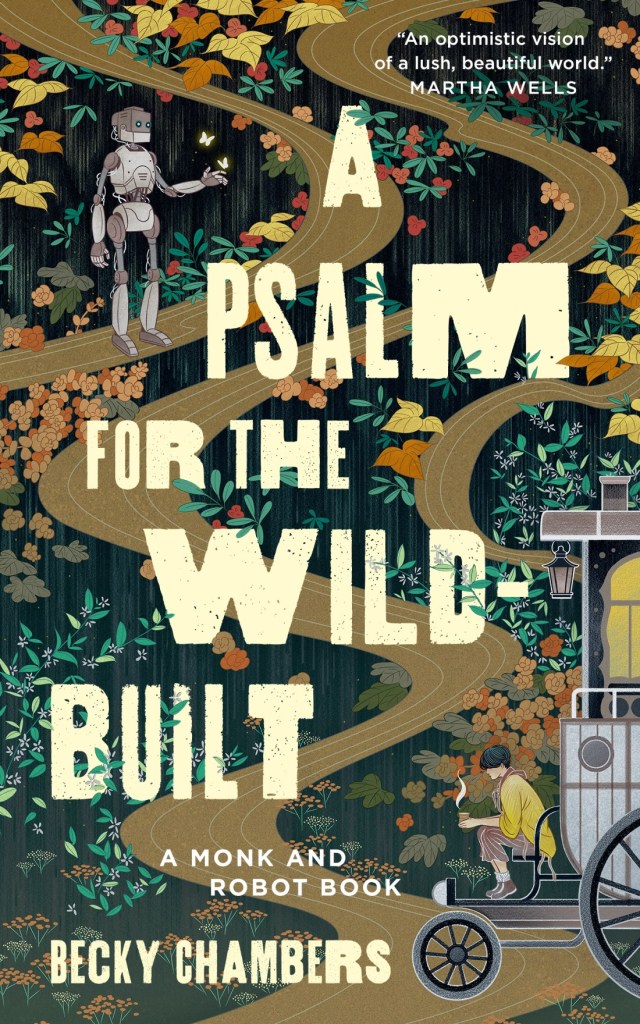
“Don’t take away my agency,” says a curious robot, trying to help a tea monk carry his cart up a steep cliff (Chambers, 2021). It’s a line I quote to clients often — and one I’m still learning to embody myself. My poor partner hears me say this to him as well, “can you hold the door open for that stranger? If you want, it would be polite– don’t let me take away your agency!” He then rolls his eyes and says something like, “I want to be a good person– of course I’m going to help.”
In a world that runs faster than ever, where expectations of upholding a society becomes more demanding of our constant presence and engagement, I find myself, like many others, dreaming of the day I can run away and live in a cabin in the woods. Living off the land with my cats and partner, secluded from any semblance of city life — save for our biweekly grocery run. And maybe we’ll keep access to the internet for the sake of entertainment. Enter A Psalm for the Wild-Built by Becky Chambers: a novella that explores what it can mean to distance yourself from society to fulfill your most authentic self in nature.
The book follows Dex, a human, who, feeling completely burnt out and unfulfilled in life, chooses to drop everything and run a small tea cart in the woods. As Dex finds navigating the tea business more challenging, they come across a robot named Moscap. In this world, robots were once commodities — designed for labor — until their artificial intelligence developed the capacity to think freely. So one day, all the robots said, “how about no?” And ran away to live in the woods. A familiar pattern for all the burnt-out characters—fictional or not.
I found myself aligning this story to the patterns of Taoism– life isn’t meant to be conquered, it is meant to be experienced. You are not meant to climb a mountain for the sake of telling friends, “I did it!” but rather as a means to appreciate the view once you’re there. In a similar light, I read The Book of Joy (2016) while on my own existential journey in my late teens. One of the passages from that book included the Dalai Lama excitedly telling his guests, archbishop Desmond Tutu and primary author Douglas Abrams, about his favorite meal– which is about to be served for breakfast. Confused by this remark, Abrams asks the Dalai Lama how he can list the meal as a favorite, for he thought Buddhists are meant to disconnect themselves from the worldly pleasures. The Dalai Lama laughs and clarifies that you do not stop being human when you become a monk– favorites exist, and the small pleasures of knowing a meal you love is about to arrive are welcomed. The difference is maintaining discipline enough to not overindulge simply because your favorite meal is on your plate. You let the experience of something delicious be consumed, and you thank the meal the same you would any other, for fueling your body in necessary means.
To be, to breathe, to experience. These are the first themes overlapping our national burnout epidemic, The Book of Joy, A Psalm for the Wild-Built, and exploration of mindfulness within a therapeutic office. Why do humans struggle so much to navigate the world through an experiential lens? A deer doesn’t overthink its place in the meadow. A cat doesn’t pause to consider whether chasing a laser pointer is “productive.” But humans? We carry something called metacognition—the ability to think about our own thoughts. It is a powerful tool for growth and reflection, but it also complicates the simplest of actions. We second-guess, reframe, narrate, and moralize. We don’t just experience the laser pointer—we ask “why,” “what are we doing,” and, “what does it mean that I want this. Who AM I because of it?” It’s a level of awareness that can breed mindfulness—or analysis paralysis. And when we’re burned out, that spiraling self-awareness often creates more inertia than insight. Metacognition then ties into the second overlapping theme: agency. And from agency, there needs to be a brief touch on narrative and identity as well.
The Book of Joy (2016) has a brief moment in which we see in practice the difference between what we are taught to be (identity) and what we discover within ourselves (narrative). The archbishop may carry the identity of a Christian leader, but his lived narrative includes doubt, humility, and deep respect for other paths to joy. I am paraphrasing greatly, but Desmond Tutu at one point notes all the good the Dalai Lama has done for the world, and he states confidently that he cannot believe a fair and just god would damn a humanitarian to Hell simply for not choosing a westernized religion– which directly goes against other leaders’ ideologies for the same church. Like A Psalm for the Wild-Built, this book wrestles with the quiet power of self-determination—how meaning isn’t always found in grand gestures, but in choosing your values, moment by moment. In other words, to have agency: to hold control of your own life and the freedom to choose the ways you wish to navigate it, every step and misstep along the way.
Perhaps this is a good time to address agency within the role of power dynamics and complicity. It would be a disservice to Chambers not to contextualize Moscap’s intention behind him saying, “don’t take away my agency.” For, robots were created with the means of being a commodity in the human world. When they left for the woods, certain individuals understood the privilege they had of being a sentient human rather than sentient robot. Dex was born into a world that once treated robots as tools, and while that system is no longer active, the shadow of it lingers—a cycle of dominance and submission that can still quietly replicate itself through well-meaning actions. Dex intrinsically struggles with the guilt of being born into a role of power and privilege, and believes the best means to resist the cycle is denying Moscap the opportunity to be commodified once again.
What might seem like a polite offer of help becomes something heavier; and there are layers of discomfort here—of shame, of inherited harm, of not wanting to repeat a past you didn’t personally create but still benefit from. While I don’t pretend to unpack the full metaphorical weight of this exchange (especially the racial and colonial undertones that can be read into it), I wish to acknowledge it in the simplest means I am able. Because the abuse of power is not simply controlling someone, it is denying them access to their own agency– whether that be brute force, or passively ignoring it for what it is. Dex struggles to push a cart up the hill, Moscap freely offers his help so neither are left waiting or struggling, and Dex denies Moscap the opportunity to help for the sake of their own discomfort of the underlying messages both parties were educated on. Instead of taking Moscap’s generosity with a momentary, “are you sure?” Dex chose to decide the narrative of both parties, which thus denied the opportunity for both to fully embrace their identities and Moscap’s agency.
Thankfully, in this variation, Moscap is empowered enough to call Dex out, to say help is not offered freely for the sake of perpetuating a cycle, and Dex can learn from the moment to think critically on them trying to manage narratives that are not their own. Afterall, if all forms of agency were denied, Dex would not have made it past thinking about their own burnout and would have been forced to stay within the city limits. Instead, they trust their ability to adapt and pursue a life that offers peace with conflicts that are within reason to Dex’s abilities.
So here’s the question I keep returning to — for myself, for clients, and for Dex:
How many narratives am I managing that were never mine to carry? If agency is the ability to choose how we show up in our own stories, then helping others — or asking for help — becomes an act of trust, not control. Like Moscap, like Dex, like all of us: we’re not asking to be saved or managed. Just seen, heard, and trusted to carry what we can. Sometimes, offering help is generous. But so is letting someone offer it back.
Let Them Choose What They Carry:
Client: I am struggling.
Me: What’s going on?
Client: I am overwhelmed at work/My family is putting too much on my shoulders/I’m moving in two weeks and haven’t started packing.
Me: I see. Have you tried asking for help?
Client: No.
Me: Why not?
Client: My boss has too much on his plate right now/My family expects me to stay the reliable one/I don’t want to be a burden.
Me: Is your boss bad at his job?/Do you claim your family as dependents on your taxes?/Are your friends secretly bad people?
Client: Of course not.
Me: Don’t take away their agency. Let them decide their limits for themselves.
Client: But what if they say yes and secretly resent me?
Me: Have you ever heard the phrase, “do unto others as you would have them do unto you?” That goes both ways. If your boss/family/friends were struggling, would you resent them for asking you for help?
Client: Of course not. I’d try to think about what I could do for them.
Me: You can give them back agency in their story. You can ask for help, and let them decide what their limits are. Give them the gift of receiving.
References
Chambers, B. (2021). A Psalm for the Wild-Built. Tordotcom.
Lama, D., Tutu, D., & Abrams, D. (2016). The Book of Joy: Lasting Happiness in a Changing World. Avery.
 Chapters, Cats, and Chaises
Leave a comment