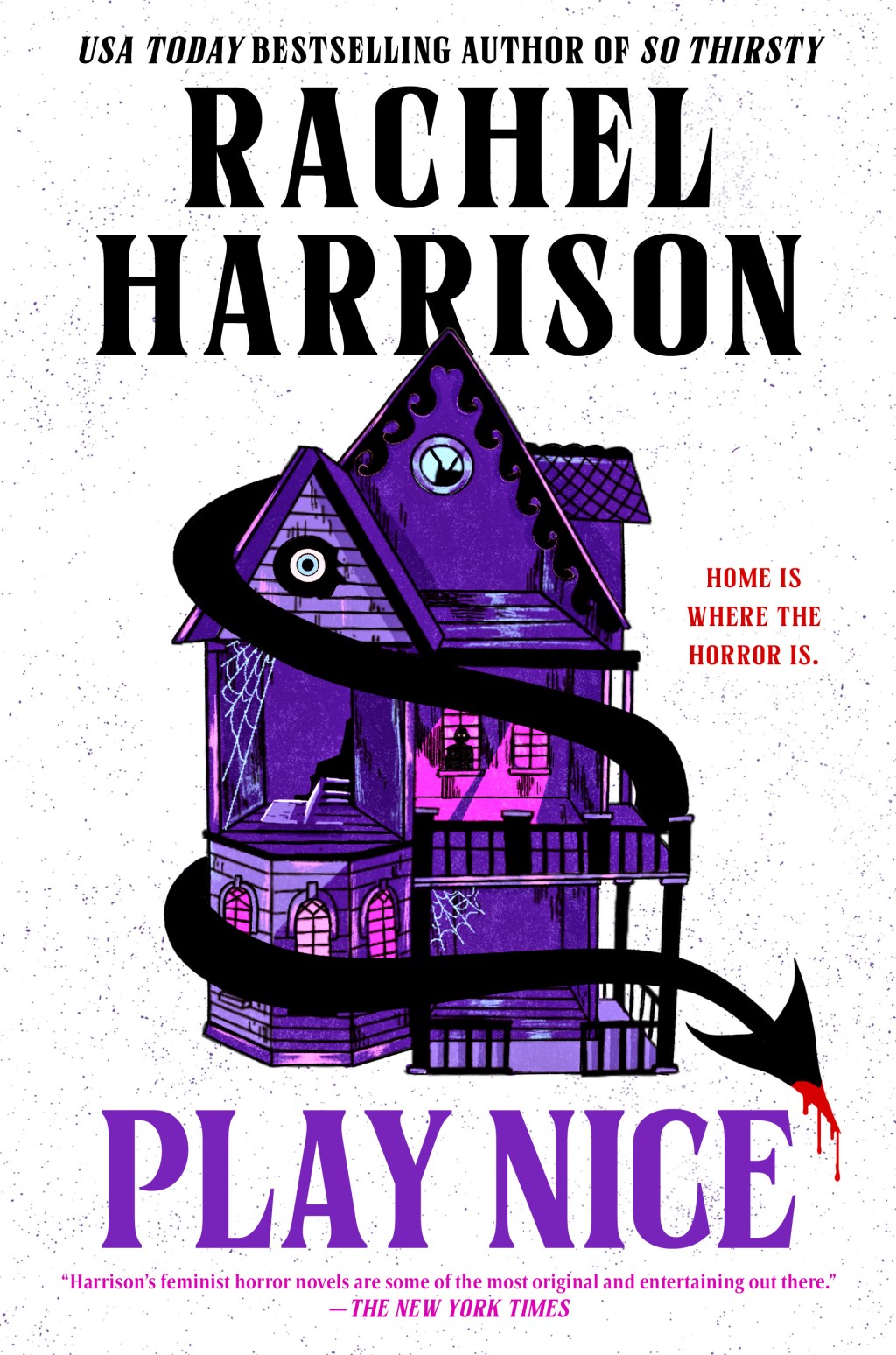
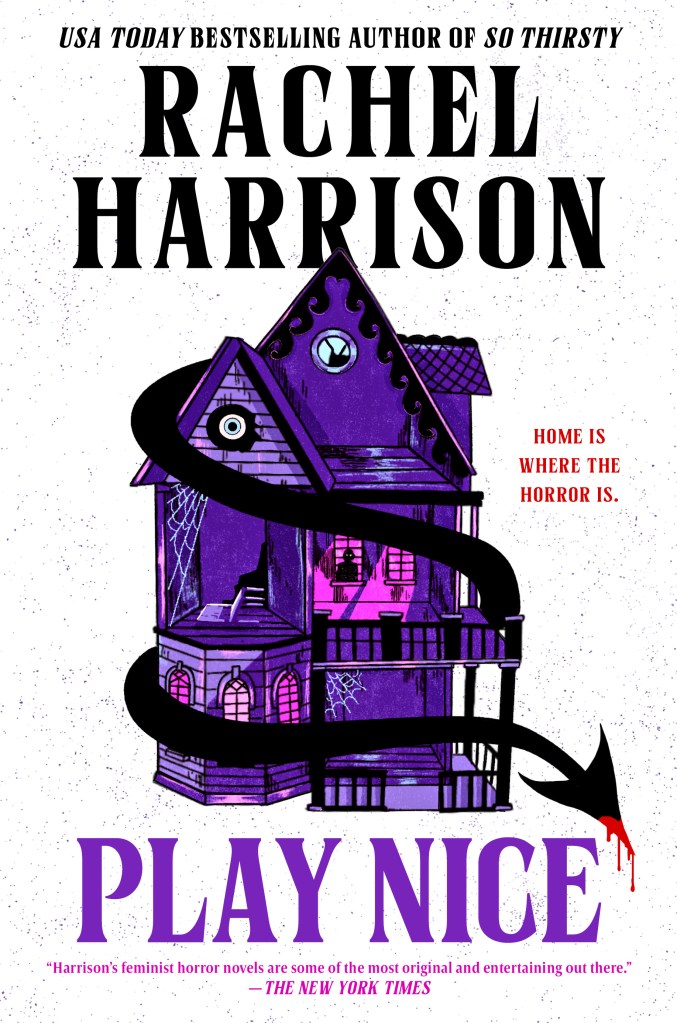
What do you do when you don’t do scary, but you’re a sucker for Spooky season? For me, I end up reading one or two books promoted as “horror,” and either regret my life choices, or find the family dramas masked as creepy crawlies. Play Nice by Rachel Harrison was thankfully one in the latter category. Marketed as horror, it is not a cozy read, but it is a spooky tale in a gothic house, exploring family trauma, and has a ghost constantly sneaking in to say, “hello.” While I had fun reading it, I have thoughts about its execution—specifically the way the haunting is used to excuse behavior rather than simply explain it.
This blog is not intended to be a full review, but I feel like my opinions on this book are best summarized in more of a review tone. As an average consumer, I thought it was fun– an easy read that I finished in about two days. As a therapist, the more I sit with the novel, the harder it is for me to compartmentalize the content with what fell flat.
We have already explored Adult Children of Emotionally Immature Parents by Lindsay C. Gibson (2015), but what exactly does it mean when I say emotionally immature? Gibson notes that emotionally immature people tend to defend their self-image instead of reflecting, even when told their behavior is hurtful; they argue for their right to act a specific way rather than own up to the impact it has on others. Play Nice does a nice job of creating rather volatile situations where each character has an opportunity to own up to their actions, and we witness them disengaging from any true form of accountability. For me, they remained rather unlikeable.
Unlikeable characters are traditionally great. In a fictional world, they play many roles in our emotional catharsis. Back in high school, I had researched nostalgia and story-telling for an assignment, and what I remember was 1) we need situations where we already know the ending, and 2) we benefit from exploring our shadow-selves in a controlled environment. When we watch people acting out, or when we have the opportunity to play the role of the bad guy, we get a sense of catharsis that can also feel rejuvenating.
We also have the opportunity to learn about the consequences of the villain’s actions without needing to risk taking the character outside of the controlled environment. We are given the opportunity to decide, “yeah, no. Being ostracized is gonna be a no from me, dawg.” Clio is a pretty unlikeable protagonist filled with many, many flaws. But when most protagonists typically reach the crux of their story, Clio’s redemption arc felt adjacent to a satisfying conclusion. When Play Nice teetered into accountability in any form, it chose to excuse the behaviors through supernatural devices. Which, in my opinion, takes away some readers’ opportunities to say, “oh dang, yeah, let’s not do what they did.”
With Harrison’s choices throughout the book– especially towards the end– I desperately needed someone to be held accountable for their actions. “If someone tells us our behavior is hurting them and we insist we’re right and entitled to treat them that way—[that] is emotional immaturity full-force” (Gibson, 2015). It seemed to me that Harrison built an arsenal for her characters on why they got to treat one another in bad and self-centered ways, then wrapped it all up nicely with a bow, completely ignoring that it was a land-mine being wrapped.
I would have appreciated the opportunity for someone to experience long-term consequences for their actions. When done well– and I believe Harrison has the skill– readers learn from the story without feeling like they witnessed an after-school, very-important-episode special. If certain people reflected on their actions and made a conscious choice to change– or if people who were hurt could say, “thank you for your perspective but this doesn’t change what you did,” I would have been satisfied.
I did not need everyone to take this route– that’s not how life works– there are plenty of individuals unprepared to change, but I needed at least one person to choose change rather than explain. Unfortunately, we do not get this in the book.
I do not want to make it seem like I disliked my time reading Play Nice. I gave it a 4/5 in my Goodreads, which is high for a genre I don’t typically read. So where does the high ranking come from? We don’t get accountability; but what we do get, is a prime example of our inner demons, and what it looks like to be “haunted” by something that feels bigger than ourselves.
I will refrain from spoiling the book, which is relatively new. But something I appreciated about this book was exploring the topic of trying to eradicate vs. making space. We as humans typically believe we cannot successfully navigate the world until we eradicate our vices. I cannot be truly happy until I stop feeling anxious. But what happens when we say, “okay, our anxiety is coming along today. Cool cool cool. Welp, I guess I can spend my day thinking about the anxiety, or I can do the day with my backpack called anxiety.”
If you have heard of the Pink Elephant Paradox/White Bear Phenomenon, you know that the more we force ourselves to not think about something, the more we end up emotionally tied to the thought (you can think about anything you want except for a pink elephant… How’s that holding up? Not a single pink elephant in your mind). Therapists who are more emotionally focused or acceptance and commitment focused are starting to recognize this paradox within our treatment plans. If we give the client permission to make space for their shadow thoughts, the client is no longer afraid of this presumed “horrible” part of themselves. If you allow space for your anxiety, eventually, it gets bored and wants to find a new way to entertain itself. Harrison starts to explore this theme in Play Nice, which left me pleasantly surprised.
Ultimately, I will continue to not read many scary books. I get nightmares, and I don’t want to add content for my nightmares to pull from. Play Nice is not inherently scary, and I made it through without any new personal trauma– but the characters have plenty to spread around. If you want a spooky but not nightmare-inducing tale, look over the content warnings and decide if this is the read for you. And remember: explanations lessen confusion; they don’t lessen impact. If Play Nice had given me even one scene of real repair, the haunt would have felt earned. As it is, I had fun—and I’m still hungry for accountability.
References
Gibson, L. C. (2015). Adult children of emotionally immature parents: How to heal from distant, rejecting, or self-involved parents. New Harbinger Publications.
 Chapters, Cats, and Chaises
Leave a comment