
And what we leave behind
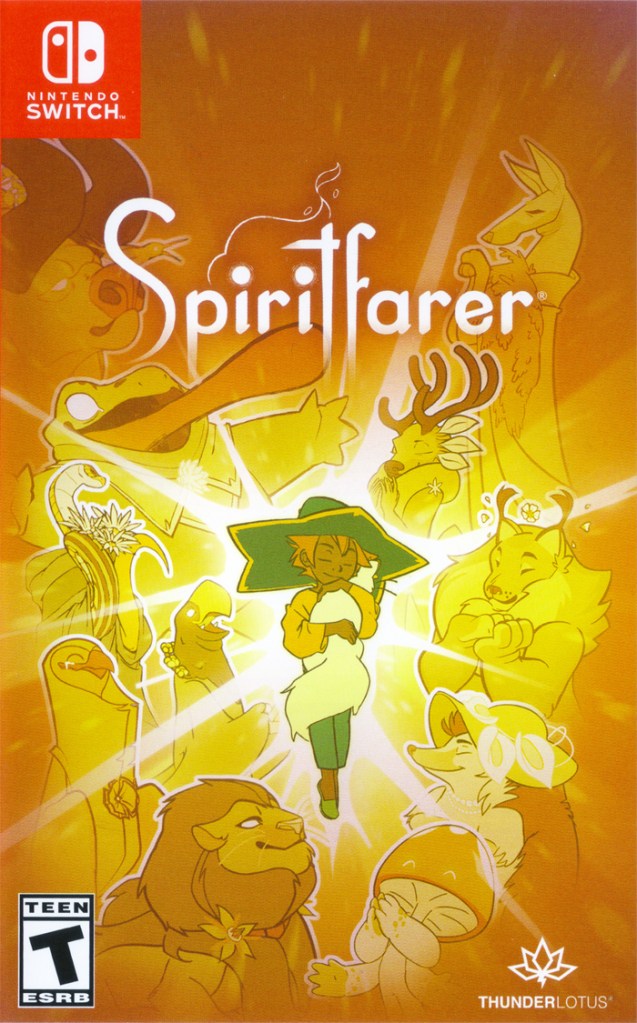
We interrupt this program for a substitute reflection! Stepping in for a traditionally-scheduled book slot, we have, on the week of Spooky Season Day (Oct 31): Spiritfarer by Thunder Lotus Games. A part side-scroller, part cozy-game, part homestead-management, and part exploration of existence.
For those who follow my weekly reflections that don’t know me, I have a history of dabbling in some video games. I would not identify myself as a “gamer,” but I go through waves of hyperfixation on either a story or style that leaves me convinced there is nothing better than the immersive world of gameplay. As an additional trivia fact about the author: my home is almost always filled with the ambience of game music, created from genius and generous minds on YouTube. Those 6+ hour playlists of game themes keep me motivated throughout my day.
One of these themes that I will listen to from start to finish as a complete soundtrack is that of Spiritfarer. Not only is the music fantastic, but what it represents is what’s left behind once we are gone– whether that shows up as completing a game, outgrowing friendships, or passing away. From start to finish to after, Spiritfarer is uniquely touching in its courage to explore grief as not only melancholy, but also as light and almost wistful.
In this game, you play Stella, accompanied by her (customizable!!!) cat, Daffodil, as she takes over Charon’s job of ferrying spirits over to the other side. However, many of these spirits have unfinished business in this land of in-between. It is your job to host these individuals on your boat, keeping them comfortable, and helping them complete their final tasks before ferrying them across to the other side– or through the Everdoor.
Sounds sad, yes? But maybe something else as well. How could a story about Stella and Daffodil, filled with spirits who are depicted as animals be anything but cozy? Thunder Lotus somehow strikes this balance. In a time when we all have grieved so many mass tragedies and personal ones as well– we all seem to be far more comfortable with sitting in the nuanced pain of grief. But once again, I will not be discussing grief as the primary subject, but rather the thesis of the game itself: what we leave behind.
Developmental theory in the field of counseling explores themes we are most likely grappling with depending on our age– babies are looking for who they can fundamentally trust; adolescents are looking for where they belong; adults are looking for meaning. The stages are more extensive, but there comes a point in our lives when we start to understand our days are finite. To live is to have an expiration date. And it is completely natural as we age to begin wondering what we are leaving behind, what our legacy might be, and if what we did in life will be remembered by anyone (Broderick & Blewitt, 2020).
Sometimes, what we are seeking is greatness. Other times, we are seeking kindness. Some have children to carry on the family name. Some of us are wanting to leave behind humanitarian legacies, while others simply want to know they hit the high score at a local arcade game. Our journeys are our own to shape and form, and each choice we make throughout the days will build on what we can be remembered by. This is an ongoing exploration throughout Spiritfarer.
Each character you discover is completely unique, grappling with their own closure on what they have left behind– often fractured and impossible to fully resolve. But one of the creative choices by Thunder Lotus was that your boat can never erase the homes you have built for each character, even once they ask you to take them to the Everdoor.
I hope to not spoil too much of the story here, but feel free to jump to the next paragraph if you want to enter this game spoiler-free. These characters are designed in a way that welcomes you to feel a connection to them all in their own way. Then leaves us with one final legacy: their goodbye. Just the single spirit, you, and Daffodil, on a boat, crossing to the Everdoor while the character offers final reflections on their sense of meaning. But these characters, fully fleshed out, all cope with their final moments of vulnerability in fashion to who they already were– what if the person can’t remember why they’re on the boat? What if they’re leaving long before life gives them the chance to stay? What if their unfinished business is knowing their legacy is hurting others? What if they leave… before you get the chance for a final goodbye?
My sister and I have an unspoken pact: if we genuinely think the other person will love a form of media, we gift it to the person, and that person will eventually get around to playing/watching/reading/listening to it, and update the other on their thoughts. We have each other’s interests down to almost a science. She introduced me to Persona 5 Royal, I got her into Over the Garden Wall. She said I needed to try Expedition 33 and The Apothecary Diaries. I got her Stardew Valley and Spiritfarer. She, to this day, will not tell me what she thought of Spiritfarer. She narrated her entire time playing, saying who she liked and disliked– she completed it in a couple of days– and then I got one final, “well now I’m depressed.” And then she moved on to other topics.
In my defense, she insisted I’d love Omori– a psychological horror game with a Steam review that says, “this game ruined my life. Would play again.” Spiritfarer is not a disturbing type of media, but it is one that says all is fair game to explore when it comes to unfinished business. And I suppose some people are ready to face that part of life while others fight tooth and nail to avoid it until necessary. My sister is an incredibly strong person who can face the difficult truths head-on. I was honestly surprised at her reaction to this game– I suppose sometimes what we experience emotionally are truths we hold as closely as a secret. She never said she hated the game– believe you me, she would. But what this game left behind for her was something she chooses to keep for herself, and I can respect that.
Sometimes, keeping things close and sacred is a means to protect ourselves. But part of my own journey in making sense of life is exploring how often we hold onto things that are meant to be shared. Whenever I entered a newly emptied home in Spiritfarer, I couldn’t help but wish I had an opportunity to tell the spirit how much they meant to me.
When the mechanics are introduced, a spirit teaches you a new skill, and then promises to complete the task with you going forward– whether it’s singing to plants, cooking, weaving fabric, or catching stars– it is an intimate moment with its own tune to represent you and your friend connecting over a shared, often mundane, activity. And when they cross over, the task becomes yours alone, with only the memories of the cartoon frog jumping around with a flute, while the music offers the slightest bit of pain. If only I took time to tell the lion how much I loved catching stars with him before he had to leave.
So instead, in my personal life, I work to name those moments rather than keeping them private. I remind my friends I’m always proud of them. I thank them for existing. I print and frame the few photos we take together because we’re normally too busy talking. If I’m in Disneyland and I know my friend’s favorite movie is Robin Hood, I’ll spend a day and a half finding the only piece of merchandise that has those characters on it. When they mention they feel best when they’re hosting and their guests feel at home, I remember next time to thank them for always having a full fridge ready to be raided. When a moment is particularly meaningful, I pause long enough to thank them for showing up.
This game can hurt. This game can be delightful. This game can be hilarious. But the game reminds me personally of how important it is to me that I make sure to share with my loved ones what their legacy is to me– honestly, not only loved ones. I try incredibly hard to find opportunities to tell anyone what I see in them that their presence has left behind.
My sister’s and my gifting pact is unspoken, which is precious, but I hope to one day name it and let her know that it occupies a space in my mind– on a boat, in a house, that will always exist because she has lived in it. And like Stella’s boat, constantly expanding and trying to make room for the occupants that intend to join, I will continue making space for the people around me to know they have left something impactful behind, even when our time together is through. And I must say, in my career, that is often.
Lori Gottlieb, author of Maybe You Should Talk to Someone (2019) writes about the end of the therapeutic journey, saying it is the one relationship you enter knowing that one day it has to end. I remind my clients constantly that if we are doing this right, eventually they will not need me anymore. When clients are frustrated that I cannot just tell them what to do, I remind them that I’m there to help them find a way to swim– I won’t let them drown, but they still need to paddle. I don’t want to gatekeep the answers, but each person needs the opportunity to feel empowered enough to name what they need– even in their final task of therapy: naming when what they need is no more therapy.
It is an incredibly bittersweet moment. Clients are protected by HIPAA and plenty of ethical guidelines– we don’t secretly stalk your social media, or check in with your contacts on how you’re doing– as much as we might want to. To complete the therapeutic process, we must work with you on successfully saying goodbye. And once you’re back in the real world, navigating life in a more secure style, therapy becomes simply a chapter of your very long legacy.
But, even though you paid for the hours, you leave something with us too—something only you could leave. Another small house on the boat, lights still on, out at sea. Worry not, we, like Stella, respect what you have left behind, and will be maintaining that memory of you, and thinking back on when Tuesdays at 12 weren’t alone, but an agreed-upon adventure of catching stars together.
References
Broderick, P. C., & Blewitt, P. (2020). The life span: Human development for helping professionals (5th ed.). Pearson.
Gottlieb, L. (2019). Maybe you should talk to someone: A therapist, her therapist, and our lives revealed. Houghton Mifflin Harcourt.
 Chapters, Cats, and Chaises
Leave a comment