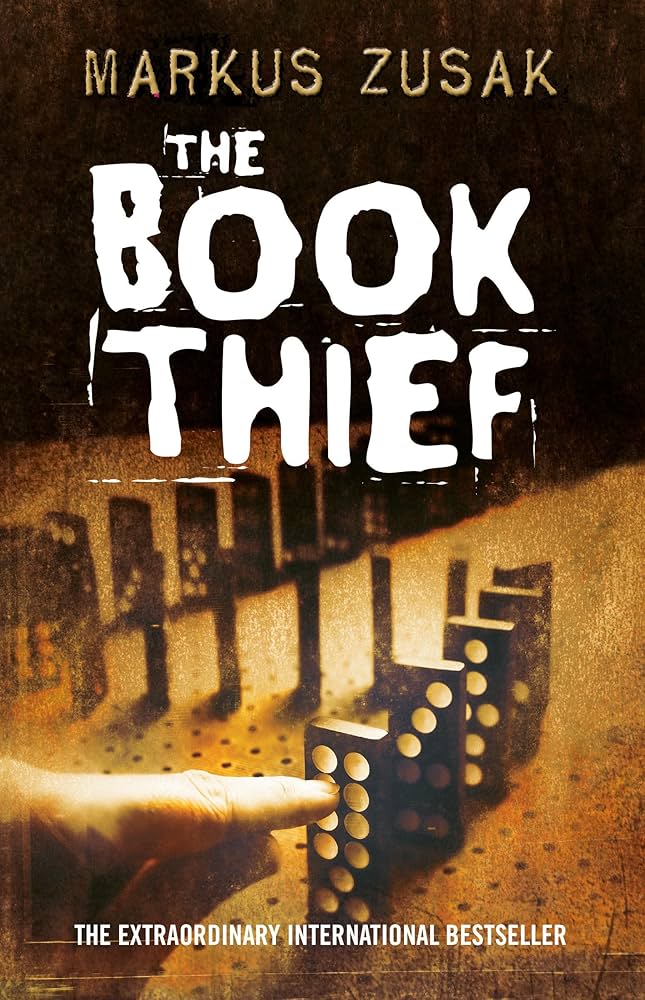
The Lord of the Rings, Piranesi, Flowers for Algernon, The Book Thief, The Hunger Games. This is the closest I have to a favorite book– a rehearsed statement of five books (trilogies count as one) that have stayed with me long past finishing the story. Each of these have left a mark on my life. They will each get the opportunity to have their time in the blogging limelight. But for today, I want to focus on the one that started it all– the one that healed my relationship with reading.
Some of these books jump mediums– I cannot read The Lord of the Rings without imagining the landscapes from Peter Jackson’s films. And Howard Shore’s scores align so well with Tolkien’s writing, the score plays in my mind whether the speakers are on or not. Similarly, I was in the prime age range to be fully engulfed in The Hunger Games franchise turning into an era of pop culture. The story remains strong, too, which I feared I might outgrow one day. Thus far, I’m still delighted by Katniss Everdeen and the Quarter Quells in the sequels.
Some books give me an introspective lens on how I treat the world around me– I’m looking at you, Flowers for Algernon and Piranesi. Not only is the writing unique, but I felt that in reading these characters, my responsibility was not to find how I’m most like Charlie or Piranesi; my responsibility was to ask how I engage with an individual that reminds me of them. Will I choose kindness every time, or will I grow impatient and abuse the trust of a vulnerable individual?
Then there is today’s spotlight– which will remain a favorite not for the quality of the story, but rather the role it played in my life. This book taught me that I can love to read, that I was good at reading, and in a similar fashion to the protagonist, that you are never too old to find that love. That title goes to The Book Thief by Markus Zusak.
Perhaps it is best to start by painting a picture. The year is 2014. I am in high school, being taught through a Classical education– reading source materials only, and then diving into philosophical dilemmas. The grading system is intense– you match the rubric of your current teacher’s highest level of education. I remember getting docked 10 points from an essay for quoting a movie instead of a book THAT WAS NOT THE ASSIGNED TOPIC. Yes, I am still bitter.
I’ve mentioned this before, but I grew insecure in my ability to read and write when I was handed Aristophanes, Aristotle, and St. Augustine before I even hit eighth grade.
My eyes were too busy being crossed or filled with tears anytime I picked up my next assignment to be able to engage with the text. And it just got more dense the closer I got to graduation.
I was miserable.
Books were the enemy.
I was destined to live a life of literate illiteracy.
But then, I heard about a book. I assumed the plot was about a girl running around WWII Nazi Germany, stealing books from the mass burnings. I rushed to get my hands on a copy, and I devoured the book.
Around 250 pages in, I pieced together that the book would have zero scenes dedicated to punching Nazis; but it proved to make lasting impacts for its authenticity. It looked for the quieter moments within a time of disaster. It was built on the image of an older gentleman with an accordion. The image of a girl on a train making eye contact with Death himself, and staying behind. About the man recreating his basement for the little girl to learn to read and write– not out of obligation for his new foster child, but out of respecting the sanctity of childlike wonder.
What this book has come to represent in my life matters far more than a suspenseful, historically inaccurate action sequence– it connected me to the tale of a lost little girl, the unconditional love of her support system, all while narrated by a burnt-out Death. Death, who is completely fed up with humanity’s constant demand for war, forcing him to work overtime and take people away from life far too soon. But a Death who is curious as to why this little girl continues to witness him but never personally crosses paths.
I have only read The Book Thief once, and I have bought six copies, because I continue to give my personal copy away to people when they ask me how it is. I honestly fear that when I do finally reopen this novel, I will discover it is not as perfect as I have shaped it to be in my mind.
One of my best friends told me she started to cry when her husband asked her to watch her favorite movie from high school with him. She said she panicked, “I need that movie to stay how it was when I needed it. What if watching it now takes that away from me?” And Zusak’s novel seems to hold a similar place in my heart.
When we finish experiencing a moment in life, all we are left with is its memory. Some experiences are ones we keep close and on repeat– I watch Friends not because I need to know what happens with Ross and Rachel; I watch it because I have seen it so many times, I remain safely in the grasp of knowing exactly what happens from start to finish.
Other memories can only be made once– driving Margo home from the animal shelter will only be lived once, but I will tell her “gotcha” story time and again. These are the ones we can safely keep close, with the peace of knowing reality stays as real as the memory.
But then there are some experiences that we can control how often we return to it, and to keep the memory precious, we choose to let the opportunity for re-experience go. Technically, we can jump out of an airplane as many times as we like, but the more often we jump, the less of an emotional resonance we keep. Perhaps this containment of re-experience is driven from fear, or perhaps it is driven from something far deeper. Either way, sometimes our favorite things are ones we need to let go of, to hold it closest to our hearts.
I so desperately want to share with you all the plot points that I remember loving in The Book Thief– the basement, the accordions, Hans, Rosa, Rudy, Max, and the actual meaning behind the title. They all live freely in my mind and heart, but I cannot trust myself to remember the reality of the book as opposed to what I have shaped the book to be in my life. What I can offer instead is a snippet of what it has left for me, and a wish that you, too, have found your favorites as well.
I hope to have the resilience of Liesel. I hope to have the kindness of Hans. I hope to have the laughter of Rudy, and the integrity of Rosa. I hope that when it is my time to go, I have lived fully enough to greet Death like an old friend. And above all, I hope to find the light in moments even when the world is in total darkness.
We don’t tend to get to decide what stays with us. We sometimes won’t recognize their impacts until many years later. But when something stays with you and lasts– whether it be books, or games, or music, or people– it is worthwhile to honor that shift in personal narrative. To unashamedly name and thank the stories that help make you who you are now.
Sometimes it doesn’t need to be a story, but even a new hobby or interest. I know my grandma identifies with her cooking– a moment of meditation and giving back to those who enter hungry. We all hold things that are precious to us, and sometimes we cannot entirely find the words to define that shift in our core– but it leaves us connected to something larger than our immediate space.
A question you will be asked early on in your therapy journey is if you feel connected to anything bigger than yourself. “What, do you mean like Jesus?” You might ask skeptically. I’ll laugh, and say not necessarily. I’d share that for me, I feel connected to lifelong learning– I think my graduate degree and constant recommendations of books for bibliotherapy makes that clear. If there’s an article, CEU, graduate course, or book– I want it.
I want to discover and unpack knowledge layer by layer. My current hyperfixation is: how do the magic of computers actually work? Because it makes less sense to me than arcane magic. It’s a lot of deep-dives and gibberish right now, but my love for lifelong learning intrinsically pulls me to keep reading.
But little does the world know that each time I have a new fixation to read about– each time I mention lifelong learning– I’m not picturing accolades or the future. All I’m picturing is teenage me in 2014, lying on my stomach, reading The Book Thief.
 Chapters, Cats, and Chaises
Leave a comment