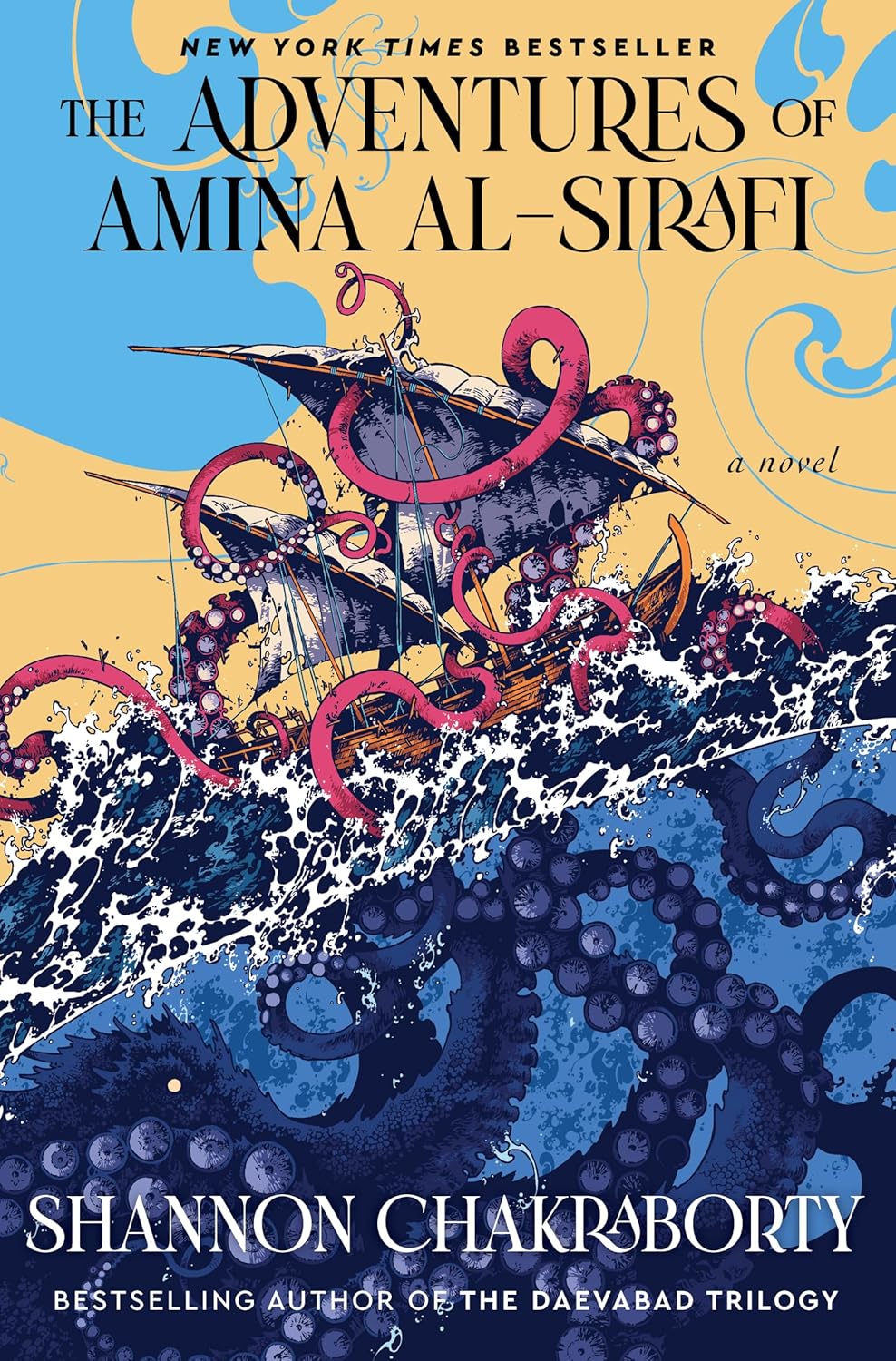
It was a cold and cozy November day not too different from today. I wandered into a whimsical bookstore with floor-to-ceiling texts ranging from used to bIt was a cold and cozy November day not too different from today. I wandered into a whimsical bookstore with floor-to-ceiling texts ranging from used to brand new. Except it was May, and the bookstore was Amazon. The book club I follow on Fable voted on a swashbuckling adventure, and I was excited to dive into the fantasy world of pirates– middle school Alyshia was a huge fan of Pirates of the Caribbean, and she had been craving a shift in her escapism for a while. When The Adventures of Amina al-Sirafi by Shannon Chakraborty was picked for the club, I had no patience to drive all the way to Barnes & Noble and grab a copy. I had to click “buy” as fast as possible, then wait impatiently by my door until it was delivered overnight.
Al-Sirafi is a great example of defying expectations because it enhances the story rather than becoming a social commentary disguised as a story. The book follows Amina, a middle-aged mother who has retired from her piratey ways in exchange for a quieter life of raising her child as a single-parent. However, as adventure novels tend to do, Amina is not allowed the peaceful living she dreams of… yet. She is coerced into boarding her ship one last time, getting the band back together, and doing one last magical adventure of seas, monsters, pirates, betrayals, and redemptions.
When was the last time you heard about a woman being the captain of a ship in a fantasy novel? How about a woman over the age of 35 being the main protagonist? For me, I don’t think I can remember– Elizabeth Swann, maybe? But she was 17 when those movies started. Captain Amelia in Treasure Planet for those millennials reading this– she fits the bill. That 2002 film about pirates in space that bombed in the box office and never gained traction for general audiences, yes. That film had the captain of the ship be a female who was also an adult. And instead we followed Jim, the teenage stowaway. I digress. That movie is fantastic and now I want to watch it once I’m done reflecting here.
Circling back: al-Sirafi is 496 pages and I read it in its entirety over a 3-day weekend. When I closed my book, unshowered and in the same pajamas I’ve marinated in for an extended weekend, I was tempted to ask myself, “was that too much?” Was abandoning my typical routine of dishes, cleaning, and prepping for the upcoming work week problematic? Was ordering DoorDash 3 days in a row so that I didn’t need to cook teetering into self-destructive? That’s a great question, I’m glad you asked.
I have a lot of clients come into my office and while we are exploring routine, habit changes, and mental wellbeing, they confess a guilty-pleasure of theirs. Typically it is that they like playing video games to decompress from a long work day. They allude to knowing it is “unhealthy,” and that they, “should be doing more productive things,” with their time. And when they complete their defensive, self-aware commentary on productivity vs play, I ask them why play is seen as a bad thing.
“Well, there’s just so much I could be doing that’s better,” they say.
“Like what?”
“I could be cleaning. Or looking for a new job. Or working out.”
“How often are you playing video games?”
“I wish I could play them all the time! But I’m so busy, usually it’s maybe an hour or two a week. Or just an entire weekend.”
We go back and forth for a while, exploring how the client’s work-life balance is looking lately, what commitments they have outside of work, how long their chores take, and we suddenly come to the same conclusion that this client is rarely getting the opportunity to just exist. To actually commit to doing nothing. To recharge in the scope of play, fun, and/or creativity.
In the book Burnout, Drs. Emily and Amelia Nagoski (2020) explore both the stress cycle, and rest with intention. They state that the human body is expected to be in a place of rest for 40% of a 24-hour cycle, or else we are entering a deficit of energy.
“FORTY PERCENT?” The client exclaims. I nod. It shocked me when I learned the percentage as well, and it is now a favorite statistic to share with clients– solely for the shock-factor. Suddenly, their 60-hour work week and immediate brain-rot on the couch is painting a fuller picture for them.
I ask them how they can decompress from the work day, if 40% of their time is meant to be in active rest. They feel less confident in listing all their expectations of productivity. They see time as a little more precious than before. When they understand the 24-hour cycle is finite, and so much of it is already accounted for, they often reshape their perspectives towards something a little more tangible and rejuvenating.
We are raised by a society that prioritizes numbers over narrative– who cares if we feel tired if the data shows productivity is perfectly fine; we don’t need to add feelings questions to surveys as long as business is booming.
The problem with this approach is that we cannot quantify all scopes of human existence. I cannot explain why my favorite color is green and a friend of mine despises it, calling it, “millenneal beige.” I don’t know why I find it so fun to host Bob Ross nights as my friends and I find more and more creative ways to insult the man trying to teach us about “happy accidents.” And in this world of productivity, there’s nobody accounting for how flinging paint brushes and accidentally staining carpets might be accounting for our motivation to work later on.
I personally think of these pauses in rigidity as an investment towards effective function. I need to service myself for shorter times if I can incorporate moments of pause more frequently. I do not reach the dreaded burnout if I make sure to stop by the gas station before my tank is completely empty. How I fill that tank is completely different from how you might refill yours, and that is okay. What matters is that sometimes, we remember to choose what we want, what our bodies say we need, and put aside the shoulds for a day– or weekend.
There is an ongoing worry that escapism is pulling us away from reality, which is often frowned upon. I have heard people compare video games to a substance use disorder. This is a tricky thing to address in a weekly blog post, but my typical response is this: we all have means of coping. These skills are all programmed into our brains for a reason, and they have a purpose.
Escapism is an excellent resource when life becomes too much, too dull, or we are feeling creatively unfulfilled. Stories have existed since the beginning of time and have brought communities together through the power of imagination. We can absolutely indulge in these moments of escape– sometimes even when we use it to escape from overwhelming news stories. It only becomes a point of concern when you are choosing to live in these alternate realities more than the real world. When you start neglecting yourself and your home more often than engaging with it, that is when it is time to pull from our arsenal of other coping skills.
We were made for this world, not to escape it entirely. We have the skills to step away once in a while, however, it is our obligation for ourselves and our loved ones to return home at night. Much like Chakraborty’s protagonist, we must remember that if we leave, someone is still anxiously anticipating your return, to wrap their arms around you in an embrace, to share a life together– platonically, romantically, parentally– someone is waiting for you.
But if it has been an exceptionally stressful month, you see you have 3 full days entirely to yourself, and you are extremely excited to spend 496 pages reading about pirates and fantasy adventure? There’s nothing wrong with committing to yourself, those moments of fun, and self-indulgence for a change. Just be sure to shower on day 3, and return to the standard practice of 40% rest and 60% work when you can.
Escapism Check-In
If you are struggling to find the balance of escapism for pleasure, and escapism for avoidance, here are a couple of check-ins you can ask yourself.
- Did I sacrifice sleep/food/meds/movement in a way that leaves me worse today?
- Did I break commitments I chose at a previous time?
- Am I putting my work, caregiving, bills at risk by disengaging right now?
- Did I blow past the time/money boundary I set in a way I can’t absorb?
- Has someone I trust voiced genuine concern about my habits lately?
- Am I getting bored of this thing, but feel like there are no other options?
If two or more of these questions are unsteady, it might be time to take a step back, reestablish stability in the real world, and return to an escape at a later time. If these questions are still secure in your time of fun, then you’re not avoiding, you’re immersed in something unique, grabbing at your attention for a while.
References
Nagoski, E., & Nagoski, A. (2020). Burnout: The secret to unlocking the stress cycle. Ballantine Books.
 Chapters, Cats, and Chaises
Leave a comment