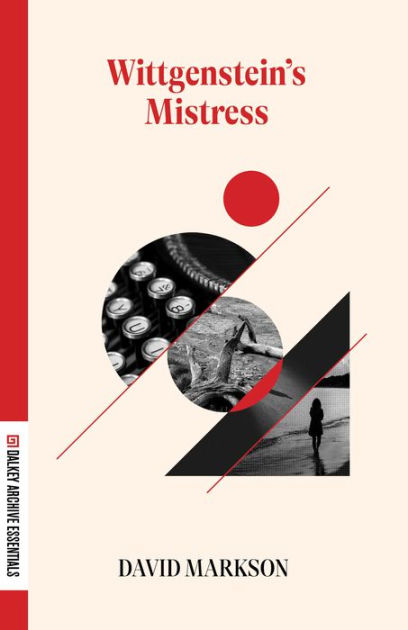
“In the beginning, sometimes I left messages in the street” (Markson, 1988). These are the ominous opening words to David Markson’s Wittgenstein’s Mistress– an experimental novel that follows the internal monologue of a woman who believes herself to be the last human on earth to exist. It is written in a free-form style, with no chapters or true breaks in the writing– if Kate is thinking it as she writes on her typewriter, it is integrated into the story in real time.
The novel is confusing, and can be difficult to follow. The writing is creative and immersive, but intentionally utilizes a voice that follows a stream of consciousness rather than traditional communication. And I suppose, if we truly believed there was nobody else to talk to, the motivation to follow conversational norms would disappear..
Kate, it seems, throughout the novel, is using the typewriter for many intrinsic needs. She wants to have others to talk to– this is apparent by the first sentence of the book, with her dropping notes in random places, wishing to one day find a response. Kate does not want to be alone, but no matter where she goes, she cannot find another person.. Therefore, she is left chatting on a keyboard, ink to paper to Kate. Additionally, Kate seems to fear what it might mean if she forgets anything. Which is to say, if she wants to remember a band’s name, or a historical event, she gets frustrated with her inability to recall, and she will return to the topic on a whim as she remembers, lest she forgets again. As the story progresses, Kate unravels in her isolation.
Another famous unraveling due to isolation, The Yellow Wallpaper by Charlotte Perkins Gilman (1892) is a short story that ends on a similarly bleak but entirely unique note. The women in these stories, locked away from human interaction, lose sight on how to navigate the world if it means being alone. They live on, but as fragments of their past selves. It becomes almost an omen to women who feel lonely, while also fueling the feminine rage of systems who prescribe isolation when women feel brave enough to ask for help.
I won’t dive into the nuances of patriarchal systems, nor will I pretend to be an expert historian on women’s health, but I do want to touch base briefly this week on isolation, loneliness, and solitude. Because, in the starting week of “holiday season” (U.S. Thanksgiving), we are entering an extremely complicated time for many individuals. And let’s be honest, complicated times for groups and family units as well.
To start, it would help to differentiate isolation, loneliness, and solitude/alone time. These words cannot be used interchangeably. Vivek H. Murthy (2020) says, “Loneliness is the gap between the social connections you need and the ones you have.” Additionally, “Loneliness is a subjective feeling … isolation is a physical state of being disconnected.” When we enter a room full of people and can’t find anyone to talk to, we are lonely; when we sit in a room devoid of another human, we are isolated.
What about those times when we intentionally shut the door to stare at the ceiling for a few hours? Is that truly so bad? What we might be experiencing is not isolation, but rather solitude. “Solitude…can be pleasant, centering, and grounding—and very important for our emotional well-being” (Murthy, 2020). We all need time and space to recharge our batteries. Being alone is not a shortcoming– I consistently spend one of my weekend days completely off the grid to recharge my battery. Just me, my cats, and probably a good book or game. I am not isolating, because I am not fearing the outside world; what I am doing is honoring my physiological system that needs alone time to decompress from a person-centered career.
What we witness from both The Yellow Wallpaper and Wittgenstein’s Mistress is a physical form of isolation, leaving women locked away from social interactions and disconnected from their support systems. Research has shown that the experience of extended loneliness can have as many health risks as smoking 15 cigarettes per day (Holt-Lunstad, et, al, 2010). The loneliness epidemic is not just in your head, and it was not simply a cry for attention from Kate or The Narrator (Jane? We actually never confirm her name, which is all the more tragic). It is a manifestation of isolation in the most extreme of circumstances.
Why did I choose to write about isolation as we enter the holiday season? Well, as I mentioned above, the holidays are a stressful and often painful time of year. If you do not live with a traditional familial setting, there is a lot of expectation around not “dampening the mood” for people who still get to celebrate with loved ones.
I tell many of my clients that humans, by nature, are herding creatures. We need our people, our tribe, our pack, to regulate our nervous systems– to show us that we are safe and that we belong. Societal expectations put that belonging into a box and tell us that we must return to our biological connections to find that sense of a herd– especially around the holiday season. But the thing is, not all biological families are safe. We do not all have the luxury to experience the holidays in a restorative way. Sometimes, during the holidays, we start to experience a sense of not having a pack to return to, and it feels safest to return to solitude rather than explain for the 45th time, “thank you for the invitation, but I would rather sit this one out.”
I want you to know I see you.
I hope you know that your tribe– your chosen family– will understand.
I do not want you to take what I said as me pushing you to attend a family reunion that will only cause pain.
What I want you to consider, though, is how you can stay connected, and how you can tend to your solitude without sliding into isolation. If you disappear completely from November through January, the health effects of prolonged isolation can take a downward turn. Speaking not as a therapist (that’s not what this blog is), but as a fellow human being, I encourage you to list your chosen family; people who maybe don’t entirely understand your situation but love you unconditionally, and have them on a short-list to contact in between the chaos of the holidays.
You do not need to shame yourself for taking moments of solitude as we enter especially trying months. You do not need to accept invitations to the family gatherings if it is too heavy for you to navigate. If your Thanksgiving will be binge-watching Breaking Bad, you have my blessing. But remember to come up for air once in a while and connect with people who recharge your social battery. Stay in contact with someone you trust, and agree to meet up in the off-weeks of these holidays. Or, if you’re feeling adventurous, start a new tradition that honors the sensation of “holiday spirit” without any ties to past incidents. You’ve got this– and you’re not alone.
Kate and The Narrator might be omens, but they are still fictional characters. They are not predicting your future. You have the skills and tools to keep yourself thriving even in moments of adversity; they never had the chance, because the author needed them to hit a low-point. Luckily, you are your own author. Write the story with a redemption arc, or make yourself the Gandalf of wisdom and deus ex machinas. The holidays will pass, you will make it through, then it’s off to your next adventure.
References
Gilman, C. P. (1892). The Yellow Wallpaper. The New England Magazine.
Holt-Lunstad, J., Smith, T. B., & Layton, J. B. (2010). Social Relationships and Mortality Risk: A Meta-Analytic Review. PLoS Medicine, 7(7), e1000316.
Markson, D. (1988). Wittgenstein’s mistress. Dalkey Archive Press.
Murthy, V. H. (2020). Together: The Healing Power of Human Connection in a Sometimes Lonely World. Harper Wave.
 Chapters, Cats, and Chaises
Leave a comment