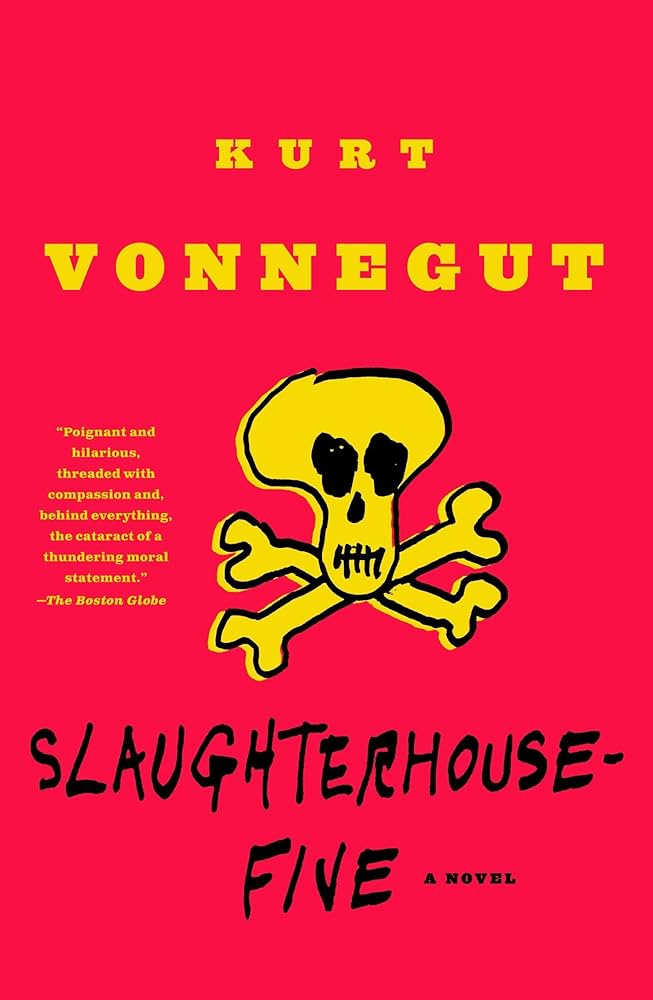
“So it goes.” This is the quote that infests the pages of Vonnegut’s novel. It is a meta-narrative on how our world is plagued with death– more specifically futile deaths that coincide with war. War– where children are enlisted to be the pawns for adults that have, “too much to lose.” The futility of such horrors is so massive, so sudden, so inescapable, all we can do is pause and acknowledge, “so it goes.”
Today, we are reflecting on another favorite novel of mine, Slaughterhouse-Five, or, The Children’s Crusade: a Duty-Dance with Death by Kurt Vonnegut. The novel follows Billy Pilgrim, a WWII veteran who lives in multiple timelines simultaneously– sometimes he’s back in the war, sometimes he’s a child, sometimes he’s in his zoo display with his porn-star lover for the alien planet Traldamadore, sometimes he’s arguing with his daughter who wants him committed for grandiose delusions.
When considering what I’d like to say about this novel, I struggled to hone in on my topics of choice– there is so much that can be explored in such an absurd and vulnerable story. Slaughterhouse-Five is one of my primary influences in starting this blog, because there are so many directions we can take in a mental health focus. I read this book for the first time as a practicing clinician, and was warned that Vonnegut can be difficult to follow. This book works impressively well as a standalone case-study on PTSD. However, as I sat down to write, I couldn’t bring myself to discuss Billy as a case-study– at least not now.
This past week has been difficult. I won’t share any sob-stories, and I won’t turn this blog into a place for me to scream into a void (you’re welcome). But I was forced to face the reality that I am in fact human, that my feelings can be hurt, and that I can very easily burn myself out. On top of that, I have many major life choices coming up that are good, but compiled the perfect portfolio for my brain to short-circuit and leave me knitting a sweater in less than six days. The inner nihilist ran rampant in this typically optimist’s mind. All I could hear, especially while contemplating Vonnegut to try and get out of my slump was, “so it goes.” Which, in turn, is what we will be exploring today.
It feels to me like I have said for the past five years, “we are in unprecedented times,” on a loop wherever I go. We had a global crisis, a global trauma, national discourses, and then an insistence on returning to the before times. A lot of my work days include people coming in to say, “the world kind of sucks right now,” and instead of a traditional pathology of depression or anxiety, I nod along because I, too, know what’s being said on the news.
As a clinician, I know to limit my consumption of the news, but I also know the moral obligation we can feel around staying informed. Nonetheless, so many news stories shared in my office lead me to internalize a phrase, “so it goes.” It is beyond my control or power to fix the planet– what can I do except acknowledge that the world is in a scary place?
Sisters Emily and Amelia Nagoski (2020) differentiate certain stressors in their book Burnout. They look at stressors you can solve (ie, a task with a deadline) versus stressors you must endure (ie, a hostile work environment in the midst of an economic crash). Neither are enjoyable, and there are coping skills to alleviate the stress cycle, but one is far simpler to resolve than the other. If I’m stressed that my kitchen stinks, I can clean out my fridge– that is entirely in my control. But when I am stuck in traffic with a full bladder, I cannot pull a Harry and the Hendersons and have bigfoot imitate a police siren to let me through. All I can do is endure, breathe, and show compassion if I wet myself.
We seem to be in a global interruption of stressors we must endure. Every news source out there wants to feed us information as fast as possible without any offer of resolution to the newest threat to our wellbeing. Each new clickbait article triggers a new stress response that dysregulates our nervous systems while none of the information is directly within our control. What is there left to do? As much as I wish I had a magic fix-it button in times like these, there is honestly not much left in my power. What I can offer is perhaps perspective.
Vonnegut wrote Slaughterhouse-Five in 1969– 56 years ago, and 24 years after the end of WWII. Humans are Chaos. There is always Something. Typically, I mention the Something as a means to help clients understand that there will always be a reason to not start change. Today I say it as a source of ironic comfort. We kind of suck– it’s almost like we are a biological species of mammals who haven’t learned their lesson that we are part of the world, not above it. When history continues and life moves on, yes, 2020-2025 will be in the books, but that’s all it will be. An omen for future humans to maybe try something different, and inevitably ignore. There is always Something. So it goes.
This does not mean we need to sacrifice our moments of happiness just because our environments are currently stressful. One of the greatest acts of defiance is to find moments of happiness even when the world tells us not to. In Persepolis by Marjane Satrapi (2003), she mentions that music was banned, but she always had dance parties to attend. And in The Diary of a Young Girl (2001), Anne Frank touches on the radio she and her family listened to– primarily for information on news sources, but also to sometimes stay connected to music.
The beauty of humanity does not need to stop simply because the horrors we commit try to blind us from the rest of it. I cannot control when people make bad decisions– but I can acknowledge the hurt and confusion before letting go enough to still find opportunities to laugh with my loved ones. There is no reason to hole away and avoid moments of beauty when they arise as frequently and unexpectedly as the challenges.
My final thought for today is this: sometimes, in moments of trauma, “so it goes,” is not a nihilistic resignation. Sometimes it is all the capacity we can offer– not silencing the injustices, but refusing to let them define our opportunities for resistance. When there is always Something, we have to find chances to continue living. Our resilience is that despite everything, we persist. In a world of Somethings, “so it goes,” must follow, so that we may continue.
References
Frank, A. (2001). The Diary of a Young Girl: The Definitive Edition (O. Frank & M. Pressler, Eds.; S. Massotty, Trans.). Bantam. (Original work published 1947)
Nagoski, E., & Nagoski, A. (2020). Burnout: The Secret to Unlocking the Stress Cycle. Ballantine Books.
Satrapi, M. (2003). Persepolis: The Story of a Childhood (M. Deissler, Trans.). Pantheon Books. (Original work published 2000)
 Chapters, Cats, and Chaises
Leave a comment