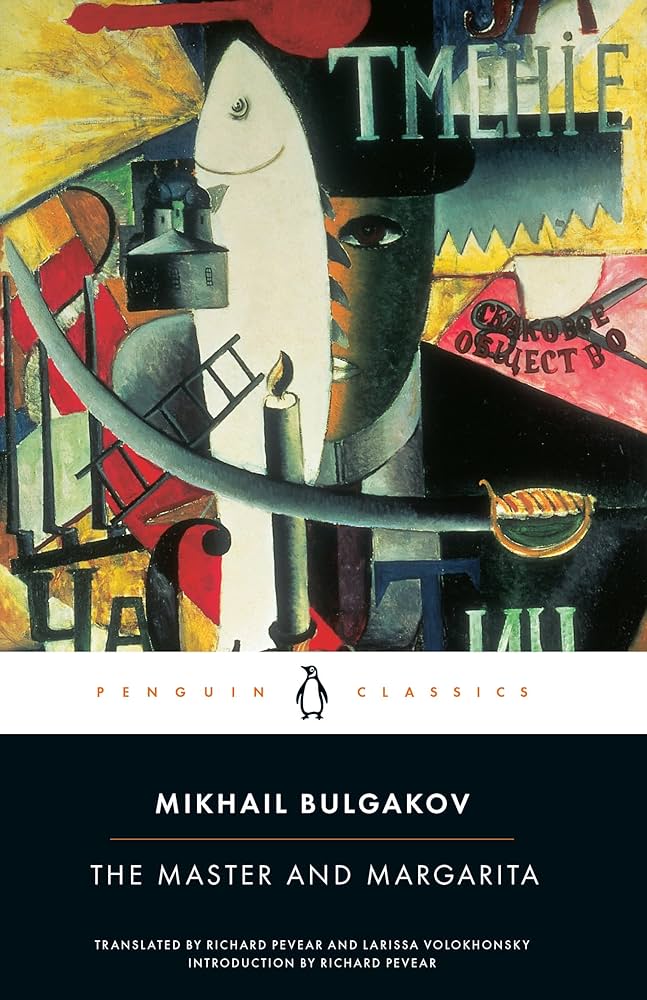
When you’re in the middle of moving, graduate school 2.0, the holidays, and the new year, all while working full time, you save the absurd Russian novels for the absurd weeks. The Master and Margarita by Mikhail Bulgakov (1967) is a novel I hadn’t heard of until a few years ago, when several clients seemed to share the same timeline and say they were rereading a favorite of theirs. The synching up that my clients seem to experience is wild to witness. They all call out the same week, and they all start binge-watching Sex and the City at the same time.
This phenomenon leads to something I like to do when I notice a trend in media from my clients, which is: consume the same media as the patterns arise. If I know more than one person is going to enter their appointment and say, “but she’s such a Miranda! She needs a Steve, not a Big!” I like to make sure I understand that reference. This is what brought me to one of the most bizarre books that I have read in a long time. Did I like it? I’m pretty sure I did. Did I feel like the book was calling me stupid the whole time? Also yes.
Where do we even begin with The Master and Margarita? I suppose we can say that instead of Georgia, the devil went down to Russia. And in a satirical meta-narrative on the Soviet era of its time– Woland (the devil) grants the most corrupt of bureaucracies their deepest desires, through the gifts at a magic show. Simultaneously, we relearn the story of Jesus Christ’s crucifixion through the perspective of Pontius Pilate. We then also learn about a third story within this already incredibly dense (but not long in word-count) Russian novel from the 1960s– this one is a love story, one about an author called The Master, and his journey to rekindle the flame of his life, Margarita. The chaos of this story has led me to reflect on self-discipline in an era of instant gratification.
Most people, I believe, can recognize that we are entering an attention deficit. With marketing, social media, and short-form entertainment, creators are finding the quickest way to grasp our attention and not lose it. I remember laughing at the original TikTok ads and thinking it would never take off, only to be whisked away, chasing the high of possibly having my video of Margo go viral. It took about two years after downloading that app before I realized that all of my free time was suddenly being lost to clips of media I barely enjoyed consuming.
On top of the hours being lost, I couldn’t help but notice the emotional whiplash I was experiencing from video to video. One moment there is a young person bonding with grandma, the next is a eulogy to a lost pet, the next is a reaction video to the state of our nation, followed by a cat with the zoomies. I couldn’t regulate faster than the videos that I felt the need to keep consuming.
Then, something hit me: Bulgakov’s Moscow is a world of constant distraction: spectacle, gossip, temptation. Maybe we’re not far off, and our “devil at a magic show,” is the erosion of stillness itself. Because in The Master and Margarita, Woland builds his temptations from the illusion of indulgence.
I will not blame social media as the sole means of instant gratification of our era. There are plenty of vices out there that call our names and offer a, “skip the hard part,” mentality. But what happens to our psyche when we are given the reward without the work?
Without stillness, a paradox seems to form. There is an intrinsic dissatisfaction with the overstimulation of constant gratification. Dr. Anna Lembke writes in her book Dopamine Nation, “The paradox is that hedonism, the pursuit of pleasure for its own sake, leads to anhedonia. Which is the inability to enjoy pleasure of any kind” (Lembke, 2021). The pursuit of instant pleasure to dissatisfaction pipeline has been recognized across countless addictions and mental health journeys.
In truth, our motivation rarely comes from the reward, but instead the act of doing something meaningful– it is why intrinsic motivation becomes so talked about compared to extrinsic. Back when I was working in a school setting, we were told that behavior charts and reward systems were meant to be phased out, because kids would only do the work– they would only follow the rules– when they were gaining some external reward in the process. Kids were less likely to behave once the candy or prizes were removed. Which, why would they continue if their motivation was gone? The answer to motivating exponentially larger classroom sizes is still divisive, but outside of the school setting, this negotiation of discipline is still relevant.
If we are to explore the challenges with intrinsic motivation, we are doing the difficult tasks not for any measurable reward other than to complete the task. If we were to read books solely for the satisfaction of bragging to our friends, what is stopping us from hopping onto Sparknotes and Wikipedia to pretend like we read it without doing the work? Instead, we take away the pressure of feeling anything specific as an outcome, and instead pace ourselves through the journey of challenges and stillness.
Additionally, there will never be enough time in the day to do all of the things we wished we could do. When we live in a state of seeking pleasure, we lose the opportunity to experience our in-between moments. Suddenly, an hour of reprieve becomes a timer of, “skip until the next part.” We simultaneously have too much air-time and not enough executive time. Part of diving into the difficult is to reclaim our moments of “until” and make them entirely their own.
To close out, I will highlight one of my rules listed on my Reading System page. When I say I “read my vegetables,” it is through authors like Bulgakov. I know I will feel stupid, and I know I will only grasp some novels at a superficial level. But for me, reading difficult books is my act of self-preservation. I don’t think it is for everyone, but I do believe anyone can do it. If someone tells you that you’re not smart enough for Dostoyevsky, or that Euripides is secretly boring, I think that’s part of the point. It’s not to prove anything except work on your cognition skills, and maybe make your “dessert” reads actually immersive and enjoyable. And if reading is not your thing, there are plenty of other opportunities to practice self-discipline, perseverance, and motivation from doing.
Not everything needs to be decided upon for the pursuit of satisfaction and dopamine. We have other happy brain chemicals (oxytocin, serotonin, and endorphins) that are ready to jump in as well. However, these chemicals don’t thrive in instant satisfaction– so we need to find practices that we must work towards to enjoy the story. Take a breather, pause and be still, and challenge yourself for no reason other than because you can. Manuscripts can take a lifetime to write, but when your life manuscript is written, “manuscripts don’t burn” (Bulgakov, 1967).
References
Lembke, A. (2021). Dopamine Nation: Finding Balance in the Age of Indulgence. Dutton.
 Chapters, Cats, and Chaises
Leave a comment