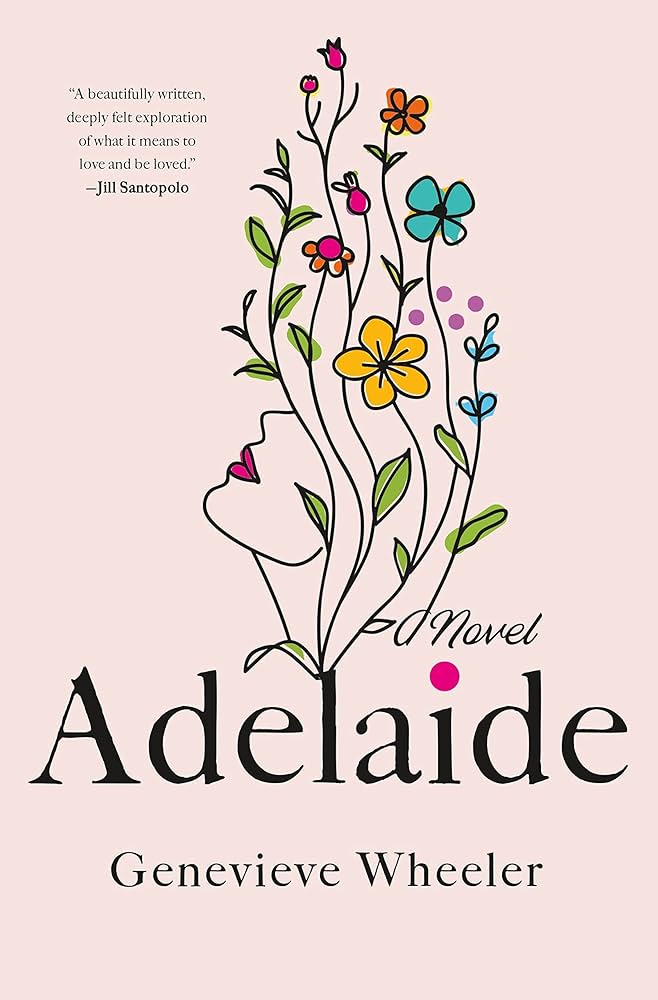
The topic I consider when looking back on my time reading Adelaide by Genevieve Wheeler is representation in media. The book follows a young professional woman as she navigates the difficult intermixings of life, work, and love. Throughout the novel, she seems to frustratingly choose to stay in a situationship that treats Adelaide with less respect than anyone deserves.
There is an authentic challenge Adelaide faces with the love interest, Rory, where she struggles to understand their situation since Rory is not doing anything explicitly wrong or bad. He simply keeps one foot outside of the relationship at all times. Tragedy then strikes, and Adelaide feels obligated to stay with Rory as an emotional tether to reality– all while neglecting her own life and wellbeing for the sake of her supposed partner.
Adelaide could easily be a discussion on partnership, attachment styles, and boundaries. However, while reading the novel, my therapist brain could not let go of certain flags presenting within the protagonist’s lifestyle. There’s sort of a known rule to not engage with media that claims to know your profession– à la teachers laughing at the fictional school budget, or a nurse pointing out that the patient should be dead. Mental health is no different (if I have to sit through another plot twist where the therapist falls in love with their client, I’m going to have an aneurysm).
But there is something that all professionals do once they’re integrated in their fields: they notice what’s there, even when it’s not the focal point. Just a week ago, I was out to dinner with a friend and her mom, an ex optometry assistant, couldn’t help but ask where I got the frames for my glasses. And the careers that shape us, stay with us beyond our time employed– I will always know the difference between a mocha and a latte thanks to my time as a barista, and I will always check the tracks on a window from my time as a window cleaner.
I have worn many hats in my life, and currently in mental health, I cannot help but sometimes hear conversational tangents as diagnostic criteria. Whether I like it or not, when a mental illness becomes a plotpoint, I cannot separate my knowledge in mental health from my passive entertainment.
With that in mind, Adelaide tested my tolerance for a good chunk of the book. Her decisions were erratic, her family history was telling, and her lack of self-awareness made me want to quit reading. I caught myself thinking, “if nothing is deemed wrong with this girl, I’m throwing my book out a window,” which is out of character for me. I speak in hyperbole, sure, but I would never think about damaging a novel, no matter how bad!
All jokes aside, Adelaide reaches a breaking point, and she is forced to face reality for what it is, which includes a mental health diagnosis. In the aftermath of our protagonist exploring courses for treatment, the book suddenly felt real and honest. Sure, the Rory frustrations felt real and honest, too– if anyone out there has experienced maintaining a relationship with someone where you’re left to do the work for both of you, it’s tough to witness. But as Adelaide began her mental health journey– at the end of the story– I caught myself comparing Wheeler’s writing to Sylvia Plath.
Back in college, I primarily learned about representation in media through my classes on disability studies. The conversation, while still present, seems to sometimes become lacking since we often pursue information on things directly impacting our personal lives. It’s not always malicious, but it is often ignorant. And while memoir sections of bookstores and libraries are filled with personal narratives on disability and mental health, accurate representations of a symptomatic individual that is not fear-driven or misinformed can be difficult to discover in works of fiction.
Then we have fictional novels that are deeply inspired by the author’s own experiences; it is almost a hybrid-model of memoir-turned-fictional-novel. Wheeler, like Plath, wrote a fictional novel, pulling from her real-life experiences in mental health. And I found that it was raw, and honest. This leaves me continuing to wonder: why is it so difficult to find mental health representation in absolute works of fiction?
Countless nonfiction mental health books are forced to address and destigmatize what certain conditions look like compared to what mainstream media produces on the stereotypes. In Unmasking Autism (2022), Dr. Devon Price pauses to recognize how characters like Sheldon Cooper in The Big Bang Theory causes individuals who are on the spectrum to be misdiagnosed from not “looking” autistic enough. In An Unquiet Mind (1995), Kay Redfield Jamison shares the struggles of self-disclosure when the media continues to represent bipolar disorder as something to fear. And in Sociopath: A Memoir (2024), Dr. Patric Gagne talks about how sociopathy is only ever mentioned when describing violent criminals, or the villains in a story, which had led her to years of confusion and misdiagnosis.
Perhaps it’s because mental illness is invisible—harder to dramatize than a physical disability. Perhaps authors fear getting it wrong and perpetuating harm. Or perhaps, as with Adelaide and Plath’s The Bell Jar, the most authentic representations come from those who’ve lived it, making the memoir/fiction boundary inherently blurry. However, if consultation and collaboration can be a key feature in my job, I truly believe we have means to collaborate with other experts to create an honest story, even if outside of our understanding. It takes extra effort and more credit to those willing to answer our questions, but part of destigmatization is 1) allowing every voice in the room to be heard, and 2) we continue to integrate differences in honest and authentic ways.
As I continue with these reflections and advocacy for my clients’ rights both in and out of my office, I’m reminded that representation matters not just for those who see themselves in stories, but for those learning to recognize struggles in others. When fiction gets mental health right, it becomes a bridge to understanding, reducing stigma one reader at a time.
While I can acknowledge progress in representation, I cannot help but recognize how the representation tends to lean on physical differences rather than the invisible boundaries many are faced with on a daily basis. I personally find we have a long way to go before this conversation will be wrapped up.
Adelaide is not a perfect novel, and Wheeler’s representation may not satisfy every clinician or lived-experience expert. But it’s a step toward the kind of fiction I hope to see more of: stories where mental health struggles exist alongside career ambitions, complicated relationships, and the daily mundanity of being human. The day our characters are as multilayered as the individuals consuming the materials won’t just be progress for representation—it will be progress for every person who’s ever wondered if their inner experience ‘counts’ as worthy of being seen.
References
Gagne, P. (2024). Sociopath: A Memoir. Simon & Schuster.
Jamison, K. R. (1996). An Unquiet Mind. Vintage Books.Price, D. (2022).
Unmasking Autism: The Power of Embracing Our Hidden Neurodiversity. Octopus Publishing Group.
 Chapters, Cats, and Chaises
Leave a comment