Do you remember when you were a child? Do you remember the first time you told a kid, “believe it or not, I was young once, too,” and then immediately realized you were old enough to sound old? What about the first time you got frustrated with a kid for them throwing a tantrum or behaving irrationally? What did you do next– did you apologize once everyone was regulated, or did you make a mental note to watch out for that problem kid?
I imagine that if this blog were to ever take off, some of you remember being the problem kid– the one with a reputation for never sitting still in class, or picking fights on the playground. I remember a childhood friend not being allowed over anymore because her reputation of vomiting mid-tantrum made its rounds amongst the adults. Being a product of my time, what I can remember growing up is feeling like those reputations tied directly to the child, rather than the adults or environments we were raised in.
I can’t help but think back on those times as an adult– as an adult with friends who are parents– and wonder: what were the adults in the room thinking? I was a relatively well-behaved kid. High energy, but polite– my sister and I got free ice cream from strangers regularly for saying, “please,” and “thank you.” I can also remember every setting where my high energy gave me a reputation as a “bad” kid. I remember spending hours on my homework to try and win the, “best effort,” candy bar in a 50-States class, only for the teacher to call me careless and messy. I was in 4th grade and the rest of the class were middle schoolers.
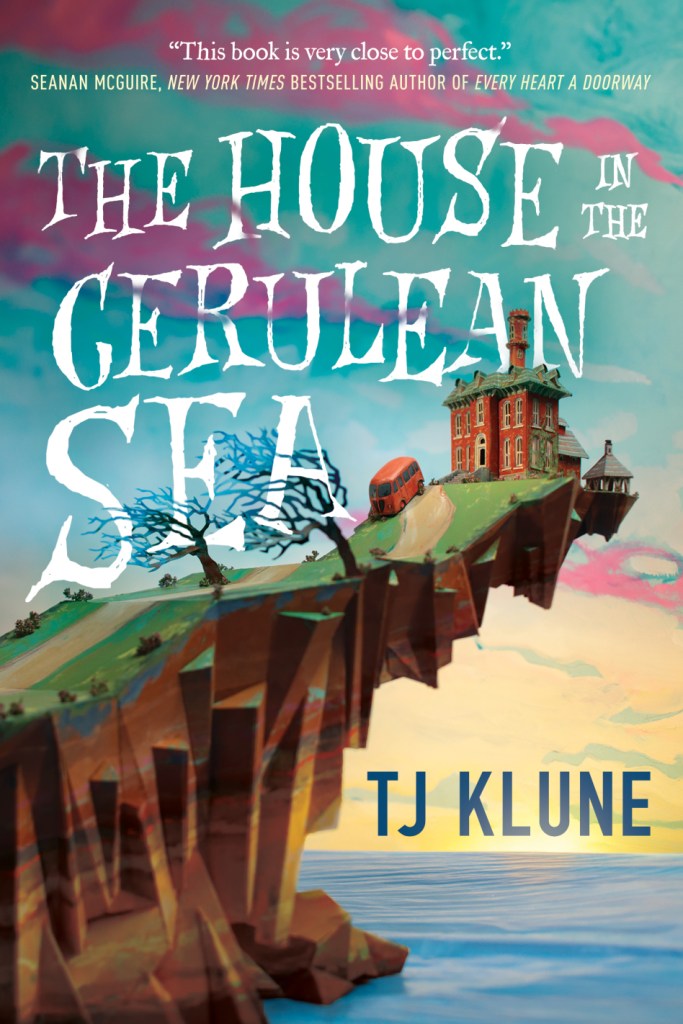
I also remember the first time I was a school counselor, and was left a spreadsheet of children’s names who were known for their “reputation.” I had a choice in that moment: follow the herd mindset, or do some investigating. I chose the latter. To probably nobody’s surprise, once I connected with the kiddos and spoke with their teachers, the students with bad reputations had one thing in common: complex home lives. That’s enough suspense– let’s dive into this week’s topic with T.J. Klune’s book The House in the Cerulean Sea.
This book covers a lot of ground on the basics of social justice, along with representation, chosen family, and living an active or passive life. All while making the reader root for the antichrist? Did I mention that part? Well, he’s six years old with spiders on the brain, and the master of the house is doing everything in his power to help nurture dear old Lucy(fer) out of his possible nature.
What I loved about this book was the emphasis on children and child welfare. For anyone who hasn’t stalked the mystery author writiing these blogs: I started out in the field of education. Working with children is a multi-generational rite of passage in my family, with grandparents working with medically fragile children which trickled down into the basepoint for my own career. Kids are smart, kids are resilient, and we need more adults who can help them foster their strength with their fragility.
Because here’s the thing: the systems we have in place are quick to flip the story of a child with behavioral differences into that of an antichrist, wyvern, gnome, or monstrous blob. We have evidence-based research that shows a child’s instinct is not to behave disruptively, but we continue to keep many helping professions uninformed on ACEs. Simultaneously, we still have systems that drag their feet on holistic interventions and trauma-informed care.
Let’s backtrack a little. What do I mean when I am talking about ACEs? The Center for Disease Control has a link which I have included down below that shares the most updated knowledge on the topic from a healthcare standpoint: ACE stands for Adverse Childhood Experiences, which are defined and measured experiences that take a specific physiological toll on the body due to acute stress at a young age. These experiences range from violence in the home, to having a parent with a severe mental illness, to having a caregiver enter incarceration, to separation of the parents (ie., divorce). While having an ACE or two is common, as the incidents are stacked, the higher a person is at risk for developing chronic health conditions– even potentially reducing a person’s lifespan by twenty years (CDC, 2023).
Before we see the long-term effects of a high ACE score, however, we are still left with the child– in the thick of acute stress, trying to navigate life in what they assume is normal– after all, they don’t have enough information to know their stress is abnormal. Their nervous system is hardwired to know, but their developing minds cannot comprehend such complex feelings of uncertainty and insecurity. In The Deepest Well (2018), Dr. Burke Harris observed something heartbreaking in her practice: children with high ACE scores were often labeled as “problem children”—disruptive, defiant, difficult to manage. But their behavior was a symptom of unaddressed trauma. A child who’s been exposed to chronic stress develops a hyperactive stress response. In other words: misbehaviors are a cry for help in the only language these kids can communicate.
How do our systems in place respond? Punishment. Suspension. Removal. Gossip. Reputations. We treat traumatized children as if they’re broken for reacting to complex adult situations like children.
Like the magical children in The House in the Cerulean Sea, real children are being seen as threats instead of kids who need help. We are looking at nature vs. nurture as a dichotomous choice– like philosophers looking at predestination vs. foreknowledge. But the truth we see time and again is that while we are byproducts of our upbringing, nothing is truly set in stone– that is, as long as someone in the system is willing to look past the expectation of number vs. narrative, a phoenix can still rise. What does that mean, you might be asking?
When I mention number vs. narrative, I am once again brought back to my time in the schools. One of my administrators constantly said, “if you want something to happen, show me the numbers, not the narrative.” This admin did not want to hear about social struggles, emotional regulation (or lack thereof), and home-life were completely out of the mix. The school system wanted numerical data-points: as a collective whole, how many of the kids surveyed said that they were “fine”? How were their test scores? If a child was really struggling, it had to be measured via a quantitative test. Narrative could not, under any circumstances, influence our ability to assist children protected by the school system. But I continue to wonder: why not both?
Let’s look at Linus and Arthur in Cerulean Sea. Both come from very different backgrounds and approaches when it comes to DICOMY (The Department in Charge of Magical Youth)– with Linus being by-the-books and Arthur being person-centered. Linus believes being objective and following the rules to the letter is what will give these children their best possible outcome. However, Arthur sees the cracks in the system and the biases the children will face for their lifetimes. Both men have the children’s best interests at heart, which is ultimately the story’s saving grace. The well-being of the children is never the conflict– rather it is Arthur and Linus coming together and finding the balance of rigid systems and rule-bending. Linus enters a numbers-only meeting and proclaims the kiddos’ narrative IS a data-point, and Arthur finds opportunities to trust the data and lean into the numbers AS a narrative piece.
If at any given moment, Arthur steered too far from DICOMY’s parameters, or if Linus’s goal in his career was anything other than child-welfare, the story would not have worked. The question was never, “how can we change these kids,” but instead, “what keeps these children most safe?” And in a realistic fashion, the answer was holistic. Yes, they needed a roof over their head, but they also needed emotionally mature adults leading the way. Yes, they need DICOMY to fund the home, but they also need the ability to go out in public freely. But what they needed most was for one person on the inside who was willing to advocate for them when they are too young to do it themselves.
Arthur is that person for the children on the island. Linus is the translator for the system DICOMY has designed. And in the real world? It might be a teacher, a coach, a therapist, or a neighbor. Someone who refuses to see a number and insists on seeing a child. Research shows that even one stable, caring adult can buffer the damaging stress of ACEs and significantly improve long-term outcomes (Burke Harris, 2018). One. That’s all it takes. Not a perfect parent, not a flawless system—just one person who shows up consistently and says, through their actions, “I see you. I believe in you. You’re worth the effort.”
As we break the generational cycle of pain and abuse, it will sometimes feel unfair. Someone is hurt, that same someone is picking up the pieces, and then to stop the cycle they must make selfless choices to protect the next generation. It is tiring, it is okay to grieve what was lost when it was your turn to be a child. But I believe we won’t be getting anywhere until we start asking, “don’t all children deserve to be protected? To be loved and nurtured so that they may grow and shape the world to make it a better place?” (Klune, 2020) And then work collectively as a village to make the necessary changes. Because kids are resilient. And they remember.
References:
Burke Harris, N. (2018). The Deepest Well: Healing the Long-Term Effects of Childhood Adversity. Houghton Mifflin Harcourt.
Centers for Disease Control and Prevention. (2023, November 2). Adverse childhood experiences (ACEs). https://www.cdc.gov/violenceprevention/aces/index.html
Klune, T. J. (2020). The House in the Cerulean Sea. Tor Books
 Chapters, Cats, and Chaises
Leave a comment