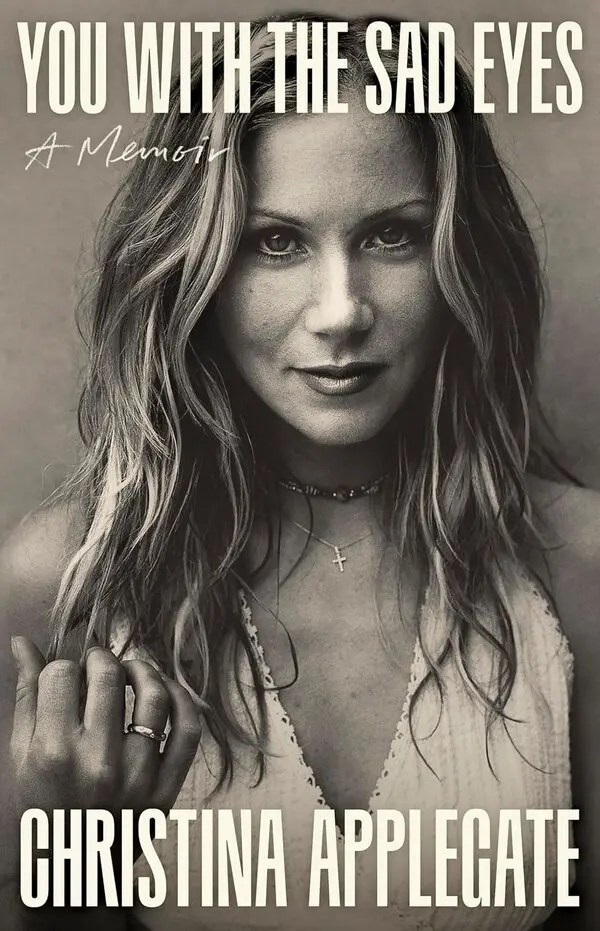
Okay, diving right in: Christina Applegate.
Or as she has announced her preferred name: Kiki.
What a gem, what a powerhouse, what a legacy.
You with the Sad Eyes: A Memoir was released on March 3rd, 2026, and I inhaled that book fast enough to read, reflect, cry, and complete a blog on it, while shifting my standing lineup to allow a post to cut in line. I don’t know what I was expecting from the book, because I don’t know a lot about this actress’s private life. What I know is that I walked away with many strong feelings. This book was one of the rawest memoirs about trauma I’ve read.
I find it interesting where reviewers and commentators are focusing on this pseudo tell-all. I have seen people highlight Hollywood reveals, ditching Brad Pitt at an awards show, salaries, and most often a comment proclaiming, “money can’t buy happiness.” Which, personally, feels like the single-story narrative many reviewers have when celebrities write their memoirs.
For example, Matthew Perry’s memoir Friends, Lovers, and the Big Terrible Thing (2022) had similar reception of, “money can’t buy happiness.” But when reading Perry’s book, I felt that his point was fame– truly inescapable attention– cannot stop you from feeling lonely. Perhaps that’s the same difference for many, but for me, I find that being in a room full of people who claim to know you is a lot more nuanced than being surrounded by enormous piles of money.
Applegate and Perry both address their privilege of success as they unashamedly list true financial numbers throughout their memoirs when relevant. However, like Perry’s book, I find it a disservice to Applegate to pretend that her overarching message is, “money can’t buy happiness.” She is grappling with a similar narrative arc around feeling unseen– she provides plenty of journal entries she has written throughout her entire life, all of which also struggle with a sense of identity– but ultimately, I believe she is writing as a means to model resilience.
From the very first chapter, Applegate wants to make several things clear: 1) we, the audience, have only ever known a marketed persona, 2) she is writing unfiltered, 3) Multiple Sclerosis sucks, 4) admitting the pain does not make her any less resilient. This last point, I think, is the most poignant epiphany a person can have in their life, status and titles aside. Because a major part of someone’s mental health journey from a trauma-informed lens is to recognize and name pain for what it is.
While reading Applegate’s memoir, all I could think about was another book called Good Morning, Monster by Dr. Catherine Gildiner (2020). This book is a challenging and often heartbreaking read– Gildiner is exploring her 5 most traumatic cases as a psychotherapist, before exploring why each client continued to seek help. One of the cases includes a woman who was greeted every day by her mom saying, “good morning, monster.” And believe me, that is mild compared to the stories explored past the cover. I wish Applegate’s memoir did not resonate at a similar level to the cases explored in Monster (I wish nobody had to endure pain or cruelty), but unfortunately, trauma doesn’t discriminate.
There is an elephant in the room, which I don’t want to focus on here, but would be a disservice to ignore. Christina shares a shocking statistic on trauma-to-MS research– well into the ninetieth percentile of increased risk. And this is true for all areas of trauma. If you would like to read more on why it is so imperative as a mental health clinician to advocate for child welfare and anti-abuse campaigns, you can read up on Adverse Childhood Experiences (ACEs). There, the data shows that most people have at least one ACE. But when you start to check more boxes, the more your health can be at risk, going so far as to potentially cut your life short by 20 years. It is scary, it is serious, and it is why it is so important you do not shrug off childhood trauma as, “just one of those things.”
However, I am taking the liberty to instead look at what I believe Applegate wanted us to understand, and what Gildiner was pushing for in her own writing: resilience is not a virtue to preach about on a sitcom’s Very Special Episode. It is something we all have, whether we can see it or not.
Whenever I start to bring up resilience in my appointments, a client inevitably rolls their eyes and says, “that word is so annoying.” When I ask why, they typically share about a time in recovery, group work, or a therapist obsessed with allegories of turtles, and how they drilled the word resilient down the client’s throat until it lost all sense of meaning. So, if that’s you, I’m sorry, I think the word is fantastic– and if you have the bandwidth for the subject matter, I think you’ll change your tune as well after reading Monster and then Sad Eyes.
Resilience means the ability to withstand and endure. When I think of the best cinematic example, I picture Captain America, always outnumbered or outweighed, standing up again and again saying, “I can do this all day,” when we all know he can, in fact, not. And then I tear up and start to cry and think about the scene in The Lord of the Rings where a tiny flute plays while Frodo and Sam are losing hope, climbing up Mount Doom, knowing there is no returning journey home for them, but Frodo sees he has to finish his job and everyone knows hope is lost and there’s no water and everything’s dark but Frodo stands back up and takes a grueling step… and then another… and then– AGH!!! I’m crying now… Okay, back to my point.
Resilience isn’t for sissies. Resilience is when all hope is lost, and by all accounts we shouldn’t even be here. But time and again, we witness stories of people who do not back down. And for every story we see where someone endures, I wholeheartedly believe there are a dozen people not sharing that they, too, have endured. It is in our human nature to have odds stacked against us, and yet we continue. For some, we fight loudly; for others, we’re too busy fighting to stay alive to be the face of a rebellion. Which is where I want to focus my energy on.
We have great movies of epics and superheroes, where they model resilience in the grandiose. But we do not have many epics of people facing just as hopeless of situations on a far more intimate scale. I have had many clients in my time who are seeking treatment after a life-altering diagnosis. And the biggest hurdle for them is always having permission to complain. “I know I have plenty to be grateful for,” or, “I know people who have it worse.” Or for Applegate’s account on fighting cancer, “it is a blessing.” Until she admits in this book, “no it’s not.”
When life is terrible, there is no gold-star waiting for you if you ignore the pain. There’s no gold star if you cry about it, either. Life can be brutal. Unfortunately, at one time or another, we all are going to face something that tests our ability to endure. Some of us will thankfully move past it. Unfortunately, some of us won’t. That’s not a determinant of strength vs. weakness, because as I said above, resilience is encoded in our DNA. We don’t have the choice to do anything else but fight like hell. It is an incredibly beautiful and humbling thing to know that no matter how many times I dramatically say, “that’s it, I give up,” my body will override my self-pity and say, “no you won’t.”
What’s interesting about that is, if resilience is not a virtue, sometimes our only conscious job is to stop fighting the override. When we pause long enough to say, “I can’t do this today,” or, “I’m just so tired.” You’re no longer forced to see those statements as flaws, but instead proof of how many odds are stacked against you. Your body is sometimes pretty dumb, but it is actually incredibly smart when it comes to enduring. You’re not ungrateful or taking things for granted when you say, “I lost everything.” Because you need time to see what life rapidly changed without your consent. You need time to say, “that thing that hurt me when I was a child was unfair, cruel, and painful.” You need permission to explain why you’re where you are today, without excusing behaviors that would hurt others.
While you process the why’s, your body has already caught on that it’s time to take over. Even if it is your physical body that has stacked the odds against itself, your resilience is not something so easily lost. Because what I have witnessed is that whether we see it or not, humanity is designed to default back to believing (whether it’s friends, family, loved ones, pets, or plants), there’s some good in this world, and it’s worth fighting for.
References
Gildiner, C. (2020). Good Morning, Monster: A therapist Shares Five Heroic Stories of Emotional Recovery. Viking.
Perry, M. (2022). Friends, Lovers, and The Big Terrible Thing: A Memoir. Flatiron Books.
 Chapters, Cats, and Chaises
Leave a comment