“Until.”
A word we can grapple with on the daily.
Until I get that promotion. Until I finally work on myself. Until my place isn’t a mess. Until I’m someone other than me. Then… what?
You have permission to be… what?
What are you waiting for permission to be? Who do you believe you are now if “you” can’t be met until?
Many religions and philosophies seem to be exploring this same theme, and it is one that has needed further exploration in a therapy office as well. Call it existentialism, narrative therapy, Taoism, desperation for a diagnostic code, or Winnie the Pooh, we are neglecting the truth that we are already here. We already exist whether we find enlightenment or capitalism.
I had a client early on in my career who spent many appointments grappling with a neurodiversity diagnosis. Everywhere they looked, their vision of who they were and how they navigated life felt changed. Yet, whenever this person tried to share their new self-understanding: peers, parents, coworkers, loved ones, and strangers all reacted with, “….. yeah…?” A tone that shook this client, because they understood themselves as one thing, and the world witnessed them for who they already were.
Individuals struggling to grapple with emotional immaturity will choose to cut ties with anyone that proves to have witnessed the person’s insecurities, rather than witness their own shortcomings as part of who they are. In therapy, we associate this pattern with shame. “I said the cringe thing, and someone remembered. I must hide away now, or else the world will say I don’t belong.”
There was an essay going around of someone ashamed of their OCD diagnosis, feeling as if their support system loved them in spite of the OCD– it was a breakthrough when a close friend shared, “I love you, and I love your OCD.” A diagnosable character flaw turned out to have the same weight as a simple personality trait. He likes turtles, she needs some extra time before she feels ready to leave the house, he’s got OCD so will probably wait to eat until he’s home. There’s no more or less of a person in front of you, and you are no more or less of a person whether you “solve” what’s “wrong” with you or begin to work with who you already are.
Why are we in such a rush to change who we are before we can be witnessed? Who do we think we are now if not something other than ourselves?
Recently, I tried to rush an opportunity to upgrade my living situation into the “next stage,” whatever that means. I was excited, I leveled up, I was proving I could be a human being who checks boxes and accomplishes things until the next major milestone. What I was left with was grief, and yearning to return to the before. I was so focused on what comes next that I forgot to pause long enough to witness what I had already built, and to just be in the presence of life.
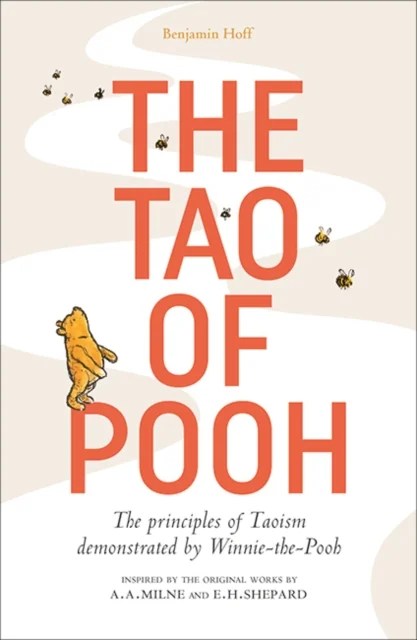
The Tao of Pooh is an open dialogue on who we are, what it means to be, and why Pooh Bear, Tigger, Piglet, Eeyore and friends can find a type of peace we in the real world sometimes struggle to see. We don’t see these friends critiquing one another into the next “until.” We see a wide cast of characters who are themselves, and their flaws are equally as whole as their virtues. This spreads into our own vernacular of The Hundred-Acre Wood.
We don’t say:
I can’t love Tigger until he calms down.
Eeyore shouldn’t be invited until he smiles more.
Don’t invite Piglet until he’s less nervous.
They love Eeyore and he’s sad. Piglet is invited and might not come if his anxiety is too high. Pooh, doing his morning workout, is short, fat, and proud of that.
If we forced these characters to be anything other than who they already are, they are no longer them. If they can’t rest until they’ve accomplished an arbitrary state of accomplishment, when can they simply… be?
I’m sure you were expecting me to write in a similar formulaic pattern as I have in the past. That’s perfectly natural; I’m doubting this change of pattern myself. Can I voice my thoughts without risking my validity? Are you reading these words to find a thesis and conclusion? Am I writing for an opportunity to prove myself?
When was the last time you or I took a breath just to feel the air enter and leave our lungs?
Sometimes I need to remember: my cats don’t seem to live for the next until. If anything, they experience anxiety when I rush to check the next box. They are creatures of habit; and so are humans. Is it enlightenment to force our ways above human nature? Can we hold permission to exist because it is already happening?
Whether the world we live in is forcing an agenda on our narratives, or our anxieties are pressuring us to think ourselves into a spiral, or we have an arbitrary number-goal for our bank accounts– there’s a lot of filler time in between. When was the last time you experienced focusing on your breath turning from inhale to exhale? What about the pause in between one thought into the next?
If you are masking, unmasked, practicing radical self-acceptance, or something in between: the world already sees you. The world has the privilege to witness– what’s stopping you? If you look at yourself from a bird’s-eye view, what do you see? Are you a little more curious about your choices of characteristics? If Christopher Robin invited you into his world of wonder, what is your “and?”
We can’t rush being. That’s running in place, or sticking our hands into a running river expecting to stop the water. If we stop measuring by productivity, there is much more to live by. Suddenly, you have time to find your meaning. You have space to connect to something that is bigger than yourself. You can be a participant to the world around you, rather than a consumer. This is interdisciplinary: there is no “until” there is only “now.”
You can be broke and be an emotional shopper.
You can be slightly guarded and cope through humor.
You can work a minimum-wage job and live in shared housing.
You can be flawed. And you can be whole.
Leaves on a Stream
Okay, so. You’ve decided to become whole, to stop chasing the “until.” What now? If we knew how to be, we wouldn’t be seeking tips and tricks from the experts, right? Well, I am not your therapist, but I can share my opinions on where I’d personally start.
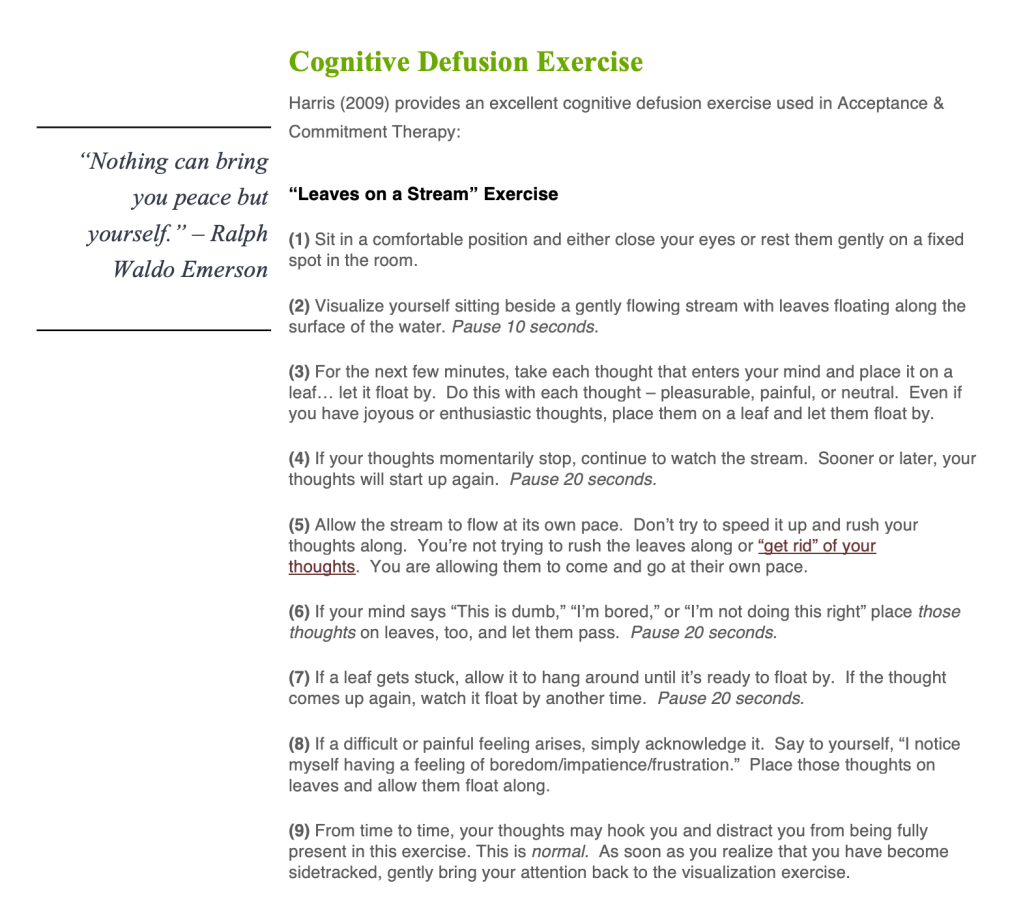
Rather than a traditional offering of a clinical citation or self-help book, I want to offer instead a guided exercise that I frequently recommend to clients. This exercise, “Leaves on a Stream” allows you the opportunity to reshape neural pathways into selecting mindfulness as a coping skill. The first several times you engage in a new coping skill, it is completely natural to think, “this is dumb… this won’t work.” It’s your brain’s defense mechanism, trying to protect your old survival skills that it already knows the outcome for.
Why try deep breathing when I can just avoid the stressor?
Nothing feels quite as good as eating that comfort food– why pretend “butterfly breaths” could replace it?
I’ve made it this far only because I have overanalyzed any possible outcome and contingency plans. In what world does, “just being present,” keep me as safe as my mental spreadsheet?
In my experience, the point isn’t to replace the coping skill, but instead offer less destructive outlets when your go-to coping is no longer in moderation. Sometimes when I’m stressed, I buy books as a release. That’s okay once in a while. But if I’m buying books every single time a stressful situation arises, I’d be neglecting my bills, and maxing out my credit cards. So, if I have practiced the ridiculous skillset of, “have you tried breathing,” preemptively, my brain will naturally start to pick breathing as an option when I know my wallet needs to stay put for a while.
I have attached the script for leaves on a stream below– but I also recommend letting this YouTube video guide you through the practice, so you can fully place your energy on participating, rather than facilitating.
Remember, the goal isn’t to stop being you. The goal is to add more to the you that already exists.
 Chapters, Cats, and Chaises
Leave a comment